


Page last updated
Tuesday 8th Sep 2026

Page written by
Victoria McCann, Communications Director
Addiction is one of the most researched and most misunderstood conditions in medicine. It’s also one of the most significant both for the person at the centre of it, and for everyone around them.
What it actually is looks quite different from how it is commonly described. It’s not a failure of character or willpower. Rather, it’s a chronic condition with recognised causes, effects on brain function, and treatment pathways.
Understanding addiction clearly – what drives it, how it develops, and what recovery from it genuinely involves – changes how it is approached.
Services
Get the support you deserve

Drug Addiction
How we help →
Cannabis Addiction
How we help →
Cocaine Addiction
How we help →
Heroin Addiction
How we help →
Ketamine Addiction
How we help →
Gambling Addiction
How we help →
Porn Addiction
How we help →
Prescription Drug Addiction
How we help →
Benzodiazepine addiction
How we help →
Opioid Addiction
How we help →
Sex Addiction
How we help →What is an addiction?
The NHS defines addiction as not having control over doing, taking, or using something to the point where it could be harmful to you.
Broadly, addiction is a recognised medical condition that changes how the brain processes reward, motivation, and self-control. It leads to compulsive use of a substance, or compulsive engagement in a behaviour, even when it’s clearly causing harm.
It is classed as a chronic, relapsing condition that can return after periods of recovery, and it tends to need ongoing management rather than a one-off fix.
It’s not a moral failing, and it’s not the same as a casual habit, or even a very strong preference for something.

What an addiction is not
The word ‘addiction’ can get used loosely. People say they are addicted to coffee, to their phone, to a TV series.
Most of the time, nobody means it clinically. While we might all use the phrasing, being overly casual can make the clinical condition harder to recognise when it shows up.
According to peer-reviewed neuroscience research, the brain’s reward circuit becomes less able to respond to non-drug rewards. Compulsive use follows, and continues despite serious harm, even when the person genuinely wants to stop.
Clinical addiction stands separately from a habit or preference. It involves changes to how the brain works, and we can broadly say that willpower isn’t the lever. Addiction is a health condition that responds to treatment, in the same way other chronic conditions do. It is not something a person can simply decide their way out of.
What causes addiction?
There is no single cause, and that itself is part of what makes addiction difficult to source, even among experts.
The American National Institute on Drug Abuse describes the difference between a normal reward and a drug-driven reward as the difference between someone whispering and someone shouting through a microphone.
Drugs and addictive behaviours produce surges of dopamine far larger than anything from everyday life. Over time, the brain adjusts by producing less dopamine on its own, or by reducing the number of receptors that can pick it up. Everyday pleasures can start to feel flat, and a person ends up needing more of the substance or behaviour to get the same effect.
Brain chemistry is only part of the picture. According to the same body of peer-reviewed research, addiction can tend to develop in people who are vulnerable because of a combination of genetics and developmental or adverse social exposures. Mental health, environment, and earlier life experience all play a part.
It’s clear that not one single factor likely explains addiction on its own.

I’m 5 years sober now and I know I wouldn’t have survived another month before I joined the treatment programme. Castle Craig is an amazingly special place where miracles really do happen, I’m blessed to have found you.

What are the different types of addiction?
Addiction takes many forms:
- Some involve a substance, where the body and brain adapt to the presence of alcohol, a drug, or a medication.
- Others are behavioural, where the same reward pathways are activated by an activity rather than a chemical.
The core mechanism is shared, but what differs is how the addiction shows up day to day, and what the right treatment approach looks like.
For that reason, more clinicians and experts in addiction distinguish between substance and behavioural addictions.
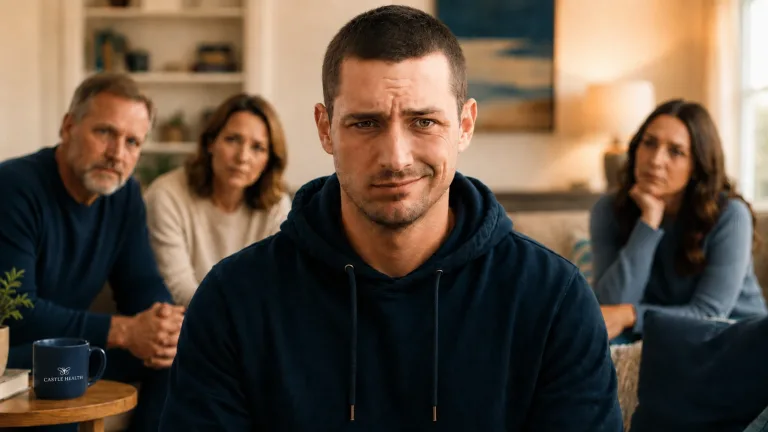
Substance addictions
Substance addictions involve compulsive use of a chemical that changes how the brain and body function. The most common forms we treat include:
- Alcohol addiction
- The different forms drug addiction can take, including stimulants, alcohol, opioids, cannabis, and dissociatives
- Prescription drug addiction, including opioids and benzodiazepines
Behavioural addictions
Behavioural addictions activate the same reward pathways as substances, without a chemical being taken into the body. They are sometimes harder to recognise for that reason, both in yourself and in someone in your life. The most common forms include:
- Behavioural addictions like gambling
- Compulsive sexual behaviours
- Pornography addiction
- Crypto and trading addiction
Signs you or someone in your life may have an addiction
The signs of addiction are better understood as potential patterns, rather than as a checklist. We can also broadly say that they show up gradually. They involve a loss of control over use, and continued use even when the harm becomes visible.
Common signs include:
- Using more, or for longer, than intended
- Finding it difficult to cut down or stop, even when wanting to
- Spending more time and money on the substance or behaviour
- Secrecy around the extent of use
- Physical or emotional withdrawal symptoms when stopping
- Continuing despite clear harm to health, work, finances, or relationships
- Losing interest in things that previously mattered
If you’re reading this about yourself, none of the above is a diagnosis. Please remember that simply noticing the patterns is a start.
If you are reading this about someone in your life, the signs can be harder to read from the outside, and often show up as changes in mood or sleep. Addiction also frequently overlaps with other mental health conditions, and the two can feed into each other. We have a separate page on how addiction and mental health often appear together if that is part of the picture.

Addiction services
Want to know more about our addiction services?
Call our admissions team today for specialist, friendly advice on what your options are and next steps.
Our locations
Locations designed to support drug and alcohol addiction recovery
With private locations across the UK and Europe, we provide care in settings that suit different needs and stages.






How addiction is treated
Addiction is treatable, and treatment usually involves a combination of medical and therapeutic support. The right approach depends on both the form of addiction and the broad scope of a person’s physical and mental health.
For most people, treatment begins with a clinical assessment and, where needed, a medically assisted detox. From there, the work moves into therapy, group support, and longer-term aftercare. Recovery is not often a single event. We plan for it as a process, with continuing care after the inpatient stage, because that is what the evidence supports.

Addiction and Mental Health
Addiction also frequently overlaps with other mental health conditions, and the two can feed into each other. We have a separate page on how addiction and mental health often appear together.
Recovery hub
Castle Health Insights & Resources



Success Stories
We’ve helped many people turn their lives around
Get help today
Take the first step in your recovery journey
We are here to listen, guide and help you every step of the way. Call us today and together we can find a solution that suits you.
Our admissions process is confidential and designed to suit and support you and your circumstances. Find out more about the Admissions process.
Telephone
From the UK: 0131 287 4071
International: +44 (131) 287 4071
Care to the highest standards
Committed to quality care
Frequently asked questions about addiction
Is addiction classed as a mental health condition?
Yes. Addiction is recognised as a mental health condition, and it is one of the most common to appear alongside others. The clinical term for that overlap is dual diagnosis, and it changes how treatment is planned.
Can you become addicted to something that isn’t a drug?
Yes. Behavioural addictions activate the same reward pathways in the brain as substance addictions, even though no chemical is taken into the body. Gambling, gaming, pornography, sex, shopping, and compulsive use of certain online platforms are all recognised forms. The clinical mechanism is similar between substance-related and non-substance-related addictions.
How long does it take to develop an addiction?
There’s no fixed timeline, and it varies between people and substances. Opioids and some stimulants can produce dependence within weeks. Others build over months or years, and behavioural addictions often develop slowly enough that the start is hard to pin down. Genetics, mental health, and circumstances all affect how quickly it takes hold.
Is addiction hereditary?
Partly. Family history of addiction raises risk, but it isn’t deterministic. Plenty of people with a family history never develop an addiction, and plenty without one do. Genetics shapes the ground that environment and experience build on.
What’s the difference between dependence and addiction?
Dependence describes the body’s physical adaptation to a substance, so that stopping produces withdrawal. Addiction is broader. It includes a loss of control and continued use despite clear harm. Someone can be physically dependent on a prescribed medication without being addicted. And someone can be addicted to a behaviour that produces no physical dependence at all.
Can someone recover from an addiction without professional support?
Some people do. But the evidence is clear that recovery rates are significantly higher with structured treatment, particularly for moderate to severe addiction. Professional support also reduces the risk of relapse, addresses any co-occurring mental health conditions, and provides the medical oversight that detox sometimes requires. Recovery without support is possible. Recovery with support is more likely, and usually more sustainable.