



Page last updated
Wednesday 16th Sep 2026

Page written on 11th September 2026 by
Victoria McCann, Communications Director
Clinically reviewed on 16th September 2026 by
Giedre Putelyte, Specialty Doctor
Gambling addiction is often underestimated. When measured against other dependencies, it can be treated as less serious. This is something difficult to reconcile with the evidence. Problem gambling is linked to a five times greater risk of death by suicide, significant financial harm, and the deterioration of relationships central to our lives.
Furthermore, it can frequently develop alongside other mental health conditions – anxiety, depression, trauma – each compounding the other in ways that make both harder to address in isolation.
Recovery from gambling addiction is well-documented and achievable, but it is something rarely achieved through willpower alone. Understanding what is driving the behaviour, and having the right clinical support to address it, is central in sustainable recovery.

our services
Get the support you need for gambling addiction



What is gambling addiction and problem gambling?
Understanding gambling addiction and problem gambling
In 2013, the American Psychiatric Association reclassified gambling disorder as a behavioural addiction in the DSM-5. The World Health Organization followed in the ICD-11, naming three diagnostic features:
- Impaired control over gambling
- Gambling taking priority over other life activities, and
- Continued gambling despite negative consequences
In short, this defines problem gambling simply as ‘gambling that disrupts life’.
Most people who gamble never develop a problem; it’s suggested that around 5% develop gambling-related problems of some kind. According to the UK government’s gambling-related harms evidence review, 0.5% of the population in England meets the threshold for problem gambling, with a further 3.8% classified as gambling at elevated risk. They may seem small, but that adds up to a lot of people.
Globally, gambling is a large and growing industry. Industry analysts forecast worldwide gambling revenue will reach 700 billion US dollars by 2028, much of that growth driven by smartphone access in lower- and middle-income countries.

Signs and symptoms of a gambling addiction
Signs of gambling addiction can be hard to see, but involve changes in behaviour, emotions, relationships, and escalating financial problems.

Behavioural signs of a gambling addiction
- Spending more and more time thinking about gambling, planning the next session, or replaying the last one.
- Chasing losses by gambling more to try to win back what was lost.
- Increasing the amount staked to feel the same level of excitement, a pattern clinicians call tolerance.
- Trying to cut back or stop, without success.
- Hiding the gambling, or lying about how much time or money it involves.
Financial signs of a gambling addiction
- Borrowing money without a clear reason, or asking for loans from several people.
- Selling possessions to fund gambling.
- Missing bills, withdrawing savings, or quietly running down accounts.
Emotional and relational signs of a gambling addiction
- Mood that rises and falls with gambling outcomes.
- Irritability or restlessness when trying to stop.
- Withdrawing from people, or becoming evasive about how time is spent.
How to recognise gambling addiction in someone in your life
From the outside, the most reliable signals are obvious money challenges and uncharacteristic behaviour. You may notice a shared bank account has less money than it should, or find a story about what someone did last weekend hard to believe.
These aren’t proof, but they’re reasonable grounds to start a considered conversation.
“Recovery happens when awareness meets acceptance. Therapy can help you move from reacting to responding, from feeling trapped to feeling choice again.”

our locations
Where we treat gambling addiction






Why is gambling addiction so difficult to stop?
Many people wonder why gambling is addictive in the first place. It’s an activity that activates the brain’s reward circuits. It releases dopamine in a similar way that substance
Multiple neurotransmitter systems are involved in gambling and pathological gambling. Over time, the brain becomes less responsive to ordinary rewards, so gambling can then start to feel less like a choice and more like a need.
Gambling also makes use of one of the strongest patterns of reinforcement that psychologists have identified. When rewards arrive on a variable schedule – sometimes after one attempt and sometimes after many – the behaviour becomes more ingrained than when rewards are predictable.
Slot machines, sports betting, casino games, online gambling apps and even positive reinforcement-based canine training are all built around this addictive principle.
People living with gambling addiction also tend to develop specific patterns of thinking that keep the behaviour going. Impulsivity and lower self-control are consistently associated with problem gambling.
These patterns often respond to therapy more reliably than argument or reasoning.

Causes and risk factors for gambling addiction
An addiction to gambling rarely comes from a single cause. The most consistent finding across research is high rates of co-occurring mental health conditions in people with an addiction to gambling.
Depression, anxiety, attention deficit hyperactivity disorder (ADHD), bipolar disorder, personality disorders – such as borderline, histrionic and narcissistic – and substance use disorders all appear at elevated rates among people receiving treatment for gambling.
One study found that over half of people with pathological gambling met criteria for non-antisocial personality disorder.
Financial stress, isolation, bereavement, and major life transitions can all raise the risk, too. So can accessibility, particularly the combination of a smartphone and betting apps.
The odds rise where exposure meets vulnerability, so we treat addiction and mental health together.

The wider impact of problem gambling
Gambling addiction rarely affects only the person living with the addiction. The UK Gambling Commission has built much of its current policy around ‘gambling-related harms’, and clinicians and researchers use the same term for the wider effects on partners, children, family and employers.
The UK government’s evidence review groups these into recognisable categories:
- Financial harms include debt, bankruptcy and, in some cases, homelessness.
- Relational harms include arguments, breakdowns of trust and, in some studies, intimate partner violence.
- Health harms include depression, anxiety, sleep problems, and an increased risk of mortality. The World Health Organization also names suicide as part of the harm picture, and the link between gambling disorder and suicidal ideation is well established.
Every Castle Health clinic screens for suicide risk as part of intake, and our clinical teams are trained to respond to it.

If you are reading this in distress, GamCare offers a confidential helpline on 0808 8020 133. The Samaritans can be reached at any hour on 116 123.
Recovery Hub
Learn more about the impacts of gambling addiction



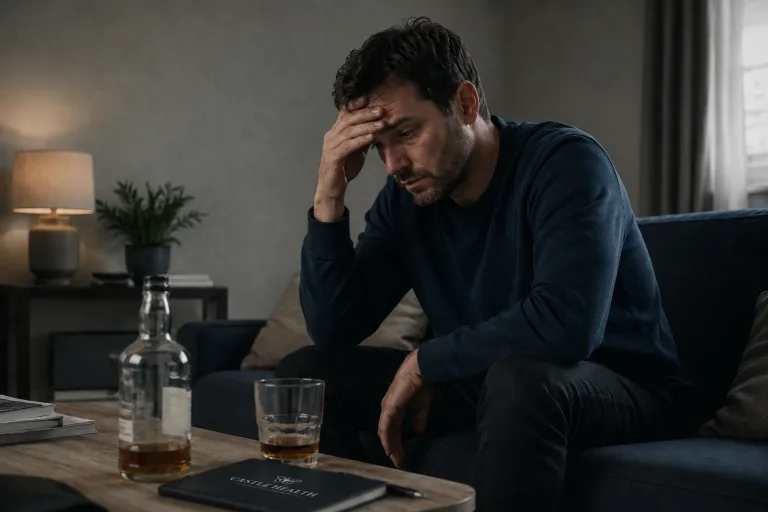
What to expect from gambling addiction treatment with Castle Health
How we approach treatment, what the first conversation looks like, and what long-term recovery from gambling addiction actually involves.

Therapy and treatment for gambling addiction
Several treatments have a good base of evidence behind them for treating gambling addiction.
- Cognitive Behavioural Therapy (CBT) carries the strongest evidence base. It works by identifying the patterns that keep gambling going, like visiting the casino when you’re stressed, or the belief a win is just around the corner.
- 12 Step Facilitation is part of every treatment programme at our residential clinics. Gamblers Anonymous follows the same fellowship model as Alcoholics Anonymous, and joining a fellowship after treatment is a reliable predictor of long-term recovery.
- Group therapy and family therapy both play important roles. Group work allows people to recognise their own experience in others, and family therapy supports rebuilding trust on both sides.
- Medication has a role for some people. Any decision on medication is made by a clinician who knows your case.
First steps when gambling addiction starts to feel out of control
If gambling has started to feel out of control:
- Tell someone, whether it’s your partner, friend, sibling, or GP.
- Register with GAMSTOP. This free, confidential national self-exclusion service blocks you from all UK-licensed online gambling sites for six months, one year, or five years.
- Use the Multi-Operator Self-Exclusion Scheme (MOSES) if you gamble in physical venues. It works across betting shops, casinos, bingo halls and arcades in Britain.
- Install a blocking app such as Gamban on your phone. Without easy access, urges are harder to act on.
- Speak to your GP, or call us. An assessment commits you to nothing other than the conversation.
Long-term recovery from gambling addiction
Recovery from gambling addiction is an ongoing process. Behavioural addictions are particularly demanding in this respect because the triggers never fully disappear. Money and phones are part of daily life, and gambling advertising appears everywhere.
Sustainable recovery is less about avoiding the world and more about building a different relationship with it.
Aftercare is built into every Castle Health programme as standard. Longer-term engagement leads to better outcomes than residential treatment alone. That means step-down therapy and continued contact with our team after discharge.
How Castle Health approaches gambling addiction
Gambling addiction is just as serious as substance addiction, and we provide the same level of care. Treatment is residential in most cases, led by a multidisciplinary clinical team specialising in addiction. Where there are co-occurring conditions, we treat them at the same time.
Castle Health provides gambling addiction rehab at Castle Craig in Scotland and Smarmore Castle in Ireland, with outpatient and online support across the UK and Europe. Admission can be arranged within 48 hours, and a residential stay usually lasts 4-12 weeks. Continuing care is part of every programme.
To read about how we approach gambling addiction recovery, see our gambling addiction treatment page. You can also find out more about Castle Health, or call us to learn about our gambling addiction help.
If someone in your life is living with gambling addiction
When you’re worried about someone else’s gambling, it can be a worrying and confusing position to be in. If you’ve started to notice changes in someone you know, a simple conversation can sometimes open their eyes to the situation.
A few things tend to help when starting a conversation:
Choose a calm time
Not the moment after an argument or disagreement. The conversation tends to go better when you are both in a good place.
Stick to what you’ve observed
Avoid leading with conclusions because this leaves no room for discussion. ‘I noticed the savings account is lower than I expected’ is more useful than ‘you have a gambling problem’.
Expect a defensive response
Shame is a powerful driver, and the first conversation is rarely the one that changes anything.
Make sure that you’re not enabling them
With gambling addiction, this might mean paying off debts or quietly covering missed bills. It happens because you care, but protecting someone from the consequences of their gambling makes it easier for the gambling to continue.
You’re also deserving of support
Gam-Anon Family Groups offers free peer meetings online and in person, and GamCare’s helpline (0808 8020 133) is open to anyone affected by someone else’s gambling. Castle Health offers family therapy for gambling addiction as part of the wider programme, with the affected others framework treating family support as a dedicated part of treatment.
Success Stories
We’ve helped many people turn their lives around
Get help today
Take the first step in your recovery journey
We are here to listen, guide and help you every step of the way. Call us today and together we can find a solution that suits you.
Our admissions process is confidential and designed to suit and support you and your circumstances. Find out more about the Admissions process.
Telephone
From the UK: 0131 287 4071
International: +44 (131) 287 4071
Care to the highest standards
Committed to quality care
Frequently asked questions about gambling addiction
Is gambling addiction more common in men or women?
Men are currently around three to four times more likely than women to meet criteria for problem gambling, though rates among women have been rising as online gambling has grown. Patterns of gambling also differ between the two.
Can someone develop a gambling addiction without losing large amounts of money?
Yes. Gambling addiction is defined by the pattern of behaviour, not by the size of the losses. People can meet diagnostic criteria for gambling disorder without having reached financial crisis.
Is online gambling more addictive than in-person gambling?
Online gambling is designed to keep you betting through 24-hour availability and push notifications. Gaming machines in physical bookies and casinos have the same designs, and carry similar risks.
Can medication help with gambling addiction?
For some people, yes. No medication is currently licensed specifically for gambling addiction in the UK, but naltrexone and other medications can be useful in particular clinical situations, especially where co-occurring conditions are present.
How is gambling addiction different from other behavioural addictions like gaming or trading?
They share underlying mechanisms. The same variable-reward patterns and dopamine pathways are involved in crypto trading addiction, gaming disorder, and other compulsive online behaviours. What sets gambling addiction apart clinically is its formal recognition in the DSM-5 and ICD-11 and the more developed evidence base for treatment.