
United Kingdom
Castle Craig, Scotland
Find out more
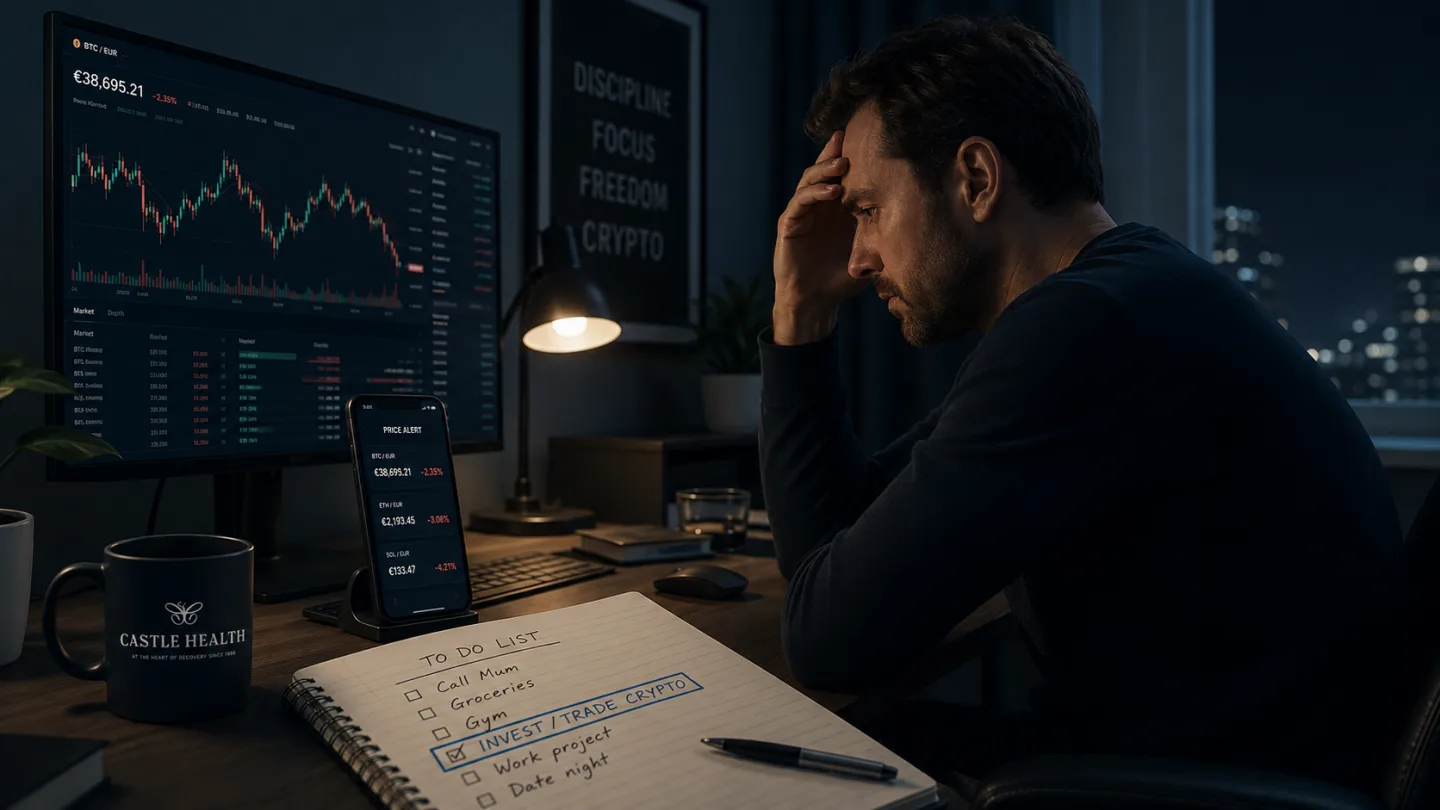


Crypto addiction is a compulsive behavioural addiction defined by loss of control over trading despite the consequences. It shares close features with gambling disorder – both for example include access to a market or platform that never closes, which you can very easily access from anywhere at any point.
While it is not yet officially classified as a unique or standalone diagnosis, crypto addiction is an informally-recognised condition, with effective treatment options. Misconceptions still exist, however. Some people, for example, wrongly think that professional trading and crypto addiction are the same thing. These misconceptions are a part of why crypto addiction can go unrecognised and untreated.
Understanding what crypto addiction is, and how it develops, can help you recognise it.

Crypto addiction is a behavioural addiction characterised by loss of control over one’s cryptocurrency trading, despite obvious harm being done. It sits in the same clinical family as gambling addiction. Both are defined by an inability to stop despite wanting to.
Find out more about how Castle Health approaches gambling addiction treatment and other compulsive behavioural addictions.
Research published in the Journal of Behavioral Addictions found that volatile assets like cryptocurrency sit between gambling and investing. And various factors contribute to crypto’s addiction potential;
Formally however, crypto addiction doesn’t yet have its own entry in diagnostic frameworks like the ICD-11 or DSM-5-TR. But, due to their similarities, it’s most often assessed and treated within the category of gambling disorder.
A 2025 study did find that cryptocurrency traders presented with higher rates of gambling disorder than non-traders. The severity of problematic trading was also strongly correlated with gambling disorder severity.
The clinical picture is well understood, even where formal classification is still developing.
Day trading is a legitimate, yet demanding skill-based profession. Successful day traders spend years – sometimes decades – developing trading psychology, risk management, technical analysis, and capital preservation skills.
They work to a defined edge, use fixed stop-losses, manage position sizing carefully, and treat trading as a job with a clear start and end.
The research draws a clear line between professional trading and gambling. There is reported to be a parallel between gamblers and day traders that only appears when loss of control is present. The skill and structure that define professional trading keep it on the right side of that line.
A professional trader who is honest about their results and works within defined parameters don’t usually experience challenges with crypto addiction.
Crypto addiction is where a loss of that discipline, or its absence from the start, plays a central part in the trading behaviour.
A 2017 paper proposed formal criteria for pathological trading, noting that the essential feature is “a maladaptive behavior related to trading, persistent or recurrent, that disrupts family, personal and/or professional activities.”
The same research noted that pathological trading leads to “a progressive loss of control over trading, tolerance and withdrawal symptoms similar to the symptoms present in substance use disorders.”
The line lies not whether someone trades, but rather whether they can stop or they’re honest about it.
“I contacted Castle Health [formerly CATCH Recovery] with a view to getting online support after a period in rehab. They recommended recovery coaching and arranged for me to meet my coach in person as the first of 10 meetings. I continued the coaching on Zoom as I live in France. I was very happy with my 10 sessions and feel I am in a good place to continue my recovery.”

When you close a profitable trade, your brain releases a surge of dopamine – a neurotransmitter linked to reward and motivation. But, the strongest dopamine response doesn’t come from the predictable, data-backed wins; it comes from uncertain rewards.
This is termed ‘intermittent reinforcement’, and it’s the same reason people keep putting money in a fruit machine that’s not paying out, or why effective positive reinforcement-based dog training includes varied reward frequency. The brain more strongly prioritises the uncertain win over the guaranteed one.
The more you trade, the weaker the response. The brain builds tolerance to the reward in a similar way to addictive substances. A bigger stake becomes necessary to produce the same response.
Most financial markets have closing times. But the crypto market has no closing bell.
Volatility is extreme: assets can move 20% in an hour, meaning the highs are higher and the losses arrive faster than most other markets.
Many brokerage platforms can also be unregulated, without the safeguards that govern traditional stock exchanges.
Crypto forums and social media channels celebrate wins and generally bury losses. There can be huge pressure for people to ‘get in’ before the next move, and a persistent sense that stepping away means missing something.
It has been noted that those with compulsive trading patterns often immerse themselves in financial literature and online forums, reinforcing a sense of infallibility that deepens the compulsion.
As Mark Douglas – one of the most influential writers on trading psychology – wrote in his book, Trading in the Zone: “They either have illusions about the nature of trading, or are addicted to it in ways that make it virtually impossible for them to be winners.”
You don’t need to have lost everything to have a problem; crypto addiction is generally defined as a loss of control over the behaviour. What it costs financially is a consequence

If someone in your life is finding it hard to step away from crypto trading, you might notice:
The signs are easier to see in someone else than in yourself. A common pattern is telling oneself the next trade will recover what was lost. These rationalisations are part of how the brain protects itself from a difficult reality.
If any of the signs above feel familiar but you’ve found reasons to dismiss them, the denial itself is part of the pattern.
ADHD can be a risk factor for compulsive trading. Anxiety, depression, and trauma are also commonly present, either as causes or as consequences.
Previous reviews have noted that anxiety and depression in traders were closely associated with market volatility. Many traders exhibited addiction-like behaviours, compulsively trading even when it resulted in financial losses. Social media was found to have a strong influence, encouraging impulsive decision-making and herd behaviour.
Trading is often used to escape difficult feelings, and the temporary relief becomes a reason the behaviour continues.
There is also a real crossover with substance use: a separate study found that cryptocurrency traders showed significantly higher rates of substance use and tobacco dependence compared to non-traders.
Where co-occurring anxiety or other mental health conditions are present alongside compulsive trading, treatment needs to address both.

You don’t need to have reached a crisis point to seek help. If you’re hiding what’s happening, that’s enough reason to reach out.
Recovery is more than possible, but it’s an ongoing process. For most people, structured support works best when it addresses the full picture.
Treatment at Castle Health draws on evidence-based Cognitive Behavioural Therapy (CBT). This helps identify and change the thought patterns that drive loss-chasing and compulsive trading. The 12 Step approach provides a framework for peer support and accountability that many people find valuable alongside formal therapy. Motivational interviewing helps people explore ambivalence around change at their own pace.
Relapse is a recognised feature of addiction, but it doesn’t mean recovery is over. There are often warning signs, like pulling back from support. Staying connected to the right people is what makes a sustained difference. Castle Health provides one year of aftercare to ensure there is advice and support for the critical time after rehab ends.
Castle Health offers outpatient and residential treatment across the UK, Ireland, and serving wider Europe. If you’re not sure what level of support is right for you, our admissions team can help you work that out.
You can also read more about what outpatient treatment looks like at Castle Health if you have commitments you can’t step away from.

Crypto addiction rarely affects only the person trading. Financial losses can mean missed mortgage payments, hidden debt, drained accounts, and decisions made without a partner knowing.
It has been found that some cryptocurrency traders showed significantly higher rates of gambling disorder and substance use than non-traders, patterns that also carry well-documented consequences for the people around them.
Beyond the money, there is the secrecy, the mood that shifts with the market, the late nights, and the slow erosion of trust.
If someone in your life is living with challenges around crypto trading, you may be uncertain about whether what you’re seeing is an addiction. Not knowing what to call it doesn’t mean you’re wrong about what you’re seeing. Family and couples therapy, and where appropriate, structured interventions, are part of how Castle Health supports recovery.
If you want to raise your concerns with them, try to choose a moment away from the screen. Speak from what you’ve seen and felt, rather than making it a confrontation.
You also need to be aware of enabling the addiction. Covering losses without question can make it easier for the behaviour to continue, even when that’s the last thing you intend.
Support for families affected by behavioural addiction is available through our dedicated family support programme. Your experience matters as much as theirs.
We are here to listen, guide and help you every step of the way. Call us today and together we can find a solution that suits you.
Our admissions process is confidential and designed to suit and support you and your circumstances. Find out more about the Admissions process.
From the UK: 0131 287 4071
International: +44 (131) 287 4071
Not as a standalone diagnosis. Gambling disorder is recognised in both the ICD-11 and DSM-5-TR, and crypto addiction is most often assessed and treated within that framework. Formal classification of a crypto-specific disorder is still developing, but the clinical picture is well understood and the framework for treatment is established.
Yes. Someone making money can still be unable to stop, hiding what they’re doing, and showing every other feature of addiction. The financial outcome doesn’t determine whether the problem is real.
Yes, in clinical terms. The specific asset matters less than the pattern of compulsive engagement and the design of the platforms involved.
Yes. Younger people are particularly at risk due to mobile access, social media exposure, and the design of trading apps. Risk increases where there is also a history of gaming or gambling.
The mechanism is similar, but the crypto environment intensifies it. The market never closes, regulation is limited, and platform design borrows heavily from gambling and gaming. Stock trading addiction exists, but the conditions specific to crypto accelerate the pattern.