



Page last updated
Friday 21st Aug 2026

Page written by
Victoria McCann, Communications Director

Clinically reviewed on 21st August 2026 by
Ralf Warren, General Practitioner
Sex addiction, known clinically as Compulsive Sexual Behaviour Disorder (CSBD), is a condition many people keep to themselves. People affected may be questioning whether what they’re experiencing counts, or they may have just discovered something about someone in their life that has worried them.
What defines sex addiction isn’t how often someone has sex. It’s about not being able to stop, despite the consequences to relationships, work, and health. The World Health Organisation’s ICD-11 classifies CSBD as a diagnosable condition, and is explicit that a high sex drive on its own doesn’t meet the threshold.
Sex addiction is not a character flaw, and it’s not a choice. At Castle Health, we treat sexual addiction as a clinical condition that frequently co-occurs with depression, trauma, and alcohol or drug use, and one that responds to treatment.

Get the support you need for sex addiction

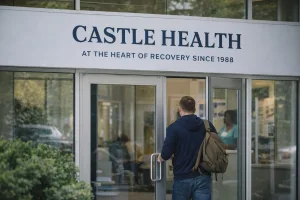

It's all about acceptance […] when you accept that you're an addict, your fighting is over. […] If you keep fighting, in the end you will lose – and that's how most people think addiction can be won, by willpower. That's the biggest mistake people make

Why sex addiction happens
Sex addiction – understanding the condition
Sex addiction does not have a single cause. Research points to a mix of neurological and psychological factors, often layered over a genetic predisposition.
At the neurological level, sexual behaviour activates the brain’s reward system in a way that is similar to the effect of many substances. Research from the University of Cambridge, funded by the Wellcome Trust, found that three brain regions showed significantly higher activity in people with compulsive sexual behaviour than in those without.
These are the same regions activated in people with substance use disorders when they encounter cues associated with their substance:
- The part that processes reward and motivation
- The part involved in anticipating rewards and craving, and
- The part that processes the emotional significance of experiences
Genetics are a factor, too. Research suggests vulnerability to addictive behaviour is roughly half genetic, half environmental. Many people with compulsive sexual behaviour have a history of trauma, emotional difficulties, or exposure to sex at an unusually early age.
According to the British Psychological Society (BPS), a survey of adults with sexual addiction found that 41% had been exposed to pornography before the age of 12.
Understanding why sex addiction develops is not about assigning blame. It’s about making sense of a pattern that can feel confusing, and giving treatment a firm foundation to build on.

Signs of sex addiction
The ICD-11 statesthat a high sex drive or high levels of sexual activity don’t meet the diagnostic threshold on their own – it is the persistent urges or impulses for repetitive sexual behavior despite harms or getting little satisfaction from this that define sex addiction.
A set of diagnostic criteria for CBSD proposed in to the World Psychiatry journal would require one or more of the following to be present
- Sexual behaviour has become a central focus of daily life, to the point of neglecting health, personal care, or other responsibilities.
- The person has made repeated, unsuccessful attempts to reduce or stop the behaviour.
- The behaviour continues despite clear negative consequences, including relationship breakdown, impact on work, or harm to physical health.
- The behaviour continues even when it brings little or no satisfaction.
The BPS also notes patterns including significant time spent on sexual activity, using sexual fantasy to manage stress, and strong urges that feel hard to resist. Men are more commonly represented in research and treatment settings. However, the BPS notes that women are likely under-represented because they’re less likely to seek treatment, not because the condition is less common.
Sex addiction, porn addiction, and love addiction – how they differ
These three conditions are frequently grouped together, and they can overlap. But they are clinically distinct, and treating them as the same thing can get in the way of accurate assessment and effective treatment:
- Sex addiction describes compulsive engagement in sexual behaviour more broadly.
- Porn addiction is specifically about the compulsive use of pornography and may or may not involve other sexual behaviour.
- Love addiction centres on an obsessive need for romantic connection, the experience of being in love, or the fear of abandonment. It may not involve sexual behaviour at all.
At Castle Health, we assess each person individually, because the right treatment depends on understanding which pattern is actually present.
How sex addiction affects life and relationships
Sex addiction doesn’t always look like a problem from the outside. Daily life can appear completely normal while the compulsive behaviour stays hidden. Keeping it hidden can be exhausting.
The BPS identifies a range of consequences including declining relationships with friends and family, feelings of guilt and shame, neglect of responsibilities, and risk of sexually transmitted infections. Financial difficulties and declining physical and mental health are also common.
A 2022 review notes that compulsive sexual behaviour is mostly presented in research as comparable to other behavioural addictions, involving loss of control, psychosocial impairment, and risky behaviour.
The same review highlights a significant gap in research on partners’ experiences. Female partners of men with compulsive sexual behaviour frequently report emotional, relational, and physical effects following discovery or disclosure. This is an area the researchers describe as seriously under-supported.
A separate chapter by Paula Hall in a volume on sexual addiction argues that assessment needs to account for attachment, trauma, and social context rather than simply patterns of behaviour. Castle Health approaches treatment as a whole-person process.
Residential treatment for sex addiction
Residential treatment is the right approach when previous attempts to change haven’t worked, or when co-occurring conditions – depression, alcohol use, unresolved trauma – need to be addressed alongside the sexual behaviour. Being away from everyday life removes some of the triggers, and makes it easier to focus on therapy.
Castle Health’s residential programme integrates individual therapy, group work, trauma-informed approaches, and 12 Step principles within a clinically supervised setting. Sex addiction frequently comes with other conditions, such as depression, alcohol use, drug dependency, and unresolved trauma. Our dual diagnosis capability means we can treat them together.
Residential treatment doesn’t resolve everything. What it does is create the conditions for serious work to begin. For more detail on what residential treatment involves, visit our page on treatment for sex addiction.
Outpatient treatment for sex addiction
Outpatient treatment suits people who can’t step away from daily responsibilities, or whose needs don’t require residential care. It can also follow a residential programme as someone moves back into ordinary life.
Outpatient programmes typically involve regular individual and group therapy sessions, with a focus on building practical coping strategies and understanding the patterns that sustain compulsive behaviour. Find out more about our outpatient options for sex addiction.
Sex addiction therapy
Cognitive Behavioural Therapy (CBT) focuses on identifying the thoughts and triggers that drive the behaviour, and building different responses. Group therapy means working through this with other people, which tends to reduce the shame around it.
Trauma-informed therapy is often central to the work, as early trauma appears frequently in the histories of people with compulsive sexual behaviour.
The 12 Step framework offers a structure that extends beyond formal treatment – one that many people find useful long after discharge. For a full overview, see our page on types of therapy for sex addiction.
"Addiction often speaks through unconscious patterns, pain, and unmet needs."
our locations
Locations designed to support your recovery




What to expect from sex addiction treatment with Castle Health
Compulsive sexual behaviour is a clinical condition, and Castle Health treats it as one. Treatment is evidence-based and delivered by a multidisciplinary team. We’re straightforward about what it can and can’t offer – recovery is a process, and we don’t pretend otherwise.
When you first get in touch, our admissions team will ask questions and listen. Nothing is agreed at that stage, and everything discussed with our team is confidential. For more on what to expect, you can read about sex addiction treatment at Castle Health.

If someone you care about needs help with sex addiction
Partners and family members can be significantly affected by compulsive sexual behaviour.
Finding out that someone in your life has been living with compulsive sexual behaviour can be hard to take in. It’s common to feel like you no longer quite know the person, and that takes time to process.
If you want to understand what’s happened, or you’re trying to work out what to do next, it helps to talk to someone who knows this territory. Our team works with partners and family members directly, and you don’t need to wait until the person in your life is ready to seek help.
If you’d like to talk to someone in confidence, our team is available. We also offer couples therapy for sex addiction, which creates a structured space for both people to work through the impact of compulsive sexual behaviour on the relationship.
Family members and partners can attend our family workshops, which run separately from the patient programme. They’re designed to help those closest make sense of what’s happened and know what to do with that.
Success Stories
We’ve helped many people turn their lives around
Get help today
Take the first step in your recovery journey
We are here to listen, guide and help you every step of the way. Call us today and together we can find a solution that suits you.
Our admissions process is confidential and designed to suit and support you and your circumstances. Find out more about the Admissions process.
Telephone
From the UK: 0131 287 4071
International: +44 (131) 287 4071
Care to the highest standards
Committed to quality care
Frequently asked questions about sex addiction
Is sex addiction officially recognised as a medical condition?
Yes. The World Health Organisation’s ICD-11, published in 2019, includes Compulsive Sexual Behaviour Disorder (CSBD) as a recognised condition. The classification also explicitly states that a high sex drive or high levels of sexual activity do not meet the diagnostic threshold. What is required is loss of control, significant distress, or clear impairment in daily functioning.
How is sex addiction different from a high sex drive?
The clinical distinction is about control and consequence, not frequency. The ICD-11 is explicit that CSBD should not be diagnosed on the basis of high levels of sexual interest or behaviour alone. What defines the condition is the inability to control the behaviour despite wanting to, and the continuation of that behaviour despite harmful consequences. A high sex drive that does not cause distress or impairment is not a clinical condition.
Can a GP diagnose sex addiction?
A GP can be a useful first point of contact and may be able to refer you to a specialist. But a formal assessment for CSBD requires a clinician with specific expertise in behavioural addiction. If you would prefer to speak to a specialist directly, Castle Health’s team can carry out an initial assessment in confidence.
How much does treatment for sex addiction cost?
The cost of treatment depends on the type of programme (residential or outpatient), the duration, and the location. Our admissions team can give you a clear overview of costs during an initial conversation. Some people are eligible for funding through their employer’s Employee Assistance Programme or private health insurance – our team can advise on this.
Are there support groups for partners of someone with a sex addiction?
Yes. S-Anon and COSA (Co-dependents of Sex Addicts) are the main peer support networks for partners and family members affected by compulsive sexual behaviour. Both operate in the UK. Castle Health also offers couples therapy as part of our treatment offering, which provides professional support alongside any peer group involvement.