



Page last updated
Tuesday 15th Sep 2026

Page written on 4th September 2026 by
Victoria McCann, Communications Director

Clinically reviewed on 15th September 2026 by
Dr Seamus Macauley, Addiction Therapist, Castle Health
Depression and addiction are among the most commonly co-occurring health conditions. They’re also often missed by those living with them. Each can look like the other, and both can feed into a painful cycle that makes sobriety harder to return to.
Asking questions about how deeply the two are connected is a natural and useful first step towards getting the help you need.
At Castle Health, our clinically led addiction treatment supports people where depression and addiction are both part of the picture.

Get the support you need for depression and addiction
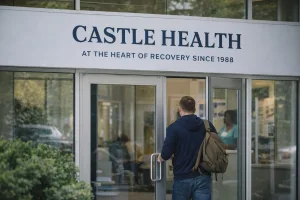


Depression and addiction: understanding your treatment options
Depression and addiction are not always separate problems. According to the UK government’s co-occurring mental health and substance use delivery framework, between 2024 and 2025, 74% of people starting drug and alcohol treatment had a mental health treatment need. Over a third of people with serious mental health condition have a co-existing drug or alcohol use disorder.
These are not edge cases, and treating only one can make recovery from the other harder. A proper assessment, one that looks at the whole picture, needs to come before any treatment plan is built.

What is depression?
Depression is a health condition that affects mood, energy, motivation, sleep, concentration, and daily functioning. A difficult week passes, but heavy depression doesn’t, not without some kind of support. When depression is present, low mood can persist for weeks or months, regardless of what is happening around you.
It can make ordinary tasks feel disproportionately hard. It can affect how you feel about yourself, the people around you, and the future. Depression is a health condition, but it is one that responds to treatment.
What is addiction?
Addiction is a health condition that involves a loss of control around alcohol, drugs, or other substances or behaviours, despite the harm they are causing. It develops through both biology and environment, as well as your past and present life experiences.
The illness of addiction affects the whole person, physically, psychologically, and in every relationship around them. It often develops gradually, and gets harder to treat the longer it goes unaddressed.
Why do depression and addiction often happen together?
The relationship between depression and addiction runs in both directions. That’s what makes it so complex.
Research describes how the two conditions share overlapping neurobiological pathways. When someone is experiencing low mood, alcohol or drugs can temporarily blunt that feeling. This is sometimes called self-medication.
But, sustained substance use changes the brain systems that regulate mood, making depression more likely, and harder to lift.
A review published in Frontiers in Neural Circuits found that people with addiction are more likely to develop depression, and people with depression are more likely to live with an addiction. The biology of both conditions overlaps in the brain’s reward circuitry.
It is not always clear which came first, and it’s not necessary to work that out before seeking support. Both conditions need to be assessed together, and that’s where treatment should begin.
Signs that depression and substance use may be connected
- Drinking or using drugs to manage low mood, anxiety, or emotional pain
- Needing more alcohol or drugs over time to get the same effect or relief
- Worsening sleep, energy, or motivation alongside heavier use
- Withdrawing from people, activities, or things that once felt meaningful
- Persistent feelings of guilt, shame, or hopelessness
- Feeling unable to stop despite wanting to
- Low mood that lifts briefly when drinking or using, then feels worse afterwards
These experiences don’t automatically mean depression and addiction are both present. But if several of them feel familiar, it is worth speaking to someone who can help you make sense of what is happening.
Why treating both conditions together matters
When depression and addiction are treated in isolation, each by a different service and at different times, the gap between them can become a risk. Substance use can worsen depression, and untreated depression can make recovery from addiction harder to sustain.
Research describes two schools of thought:
- One holds that depression in people with addiction often resolves once substance use stops
- The other is that depression should be treated alongside addiction, particularly where self-medication may be driving use
Both perspectives point to the same conclusion, an assessment that looks at both conditions is the right place to start.
Integrated treatment, where substance use and underlying mental health are addressed together, gives recovery a stronger foundation. That’s what we offer at Castle Craig and Smarmore Castle.
"I contacted Castle Health with a view to getting online support after a period in rehab. They recommended recovery coaching and arranged for me to meet my coach in person as the first of 10 meetings. I continued the coaching on Zoom as I live in France. I was very happy with my 10 sessions and feel I am in a good place to continue my recovery."

Our locations
Clinics serving Europe designed to support your recovery






What to expect from depression and addiction treatment with Castle Health
If you’re not sure whether what you’re experiencing counts as depression, addiction, or both, you’re not alone in what you feel. You don’t need a diagnosis before getting in touch.
Our admissions team can help you understand what is happening and what support is your strongest choice.

Your first conversation with our team
The first step is a confidential conversation. You can speak to our admissions team by phone. There’s no pressure to commit to anything.
Our team will ask about what you’ve been experiencing and give you a clear picture of whether Castle Health is the right fit.
If we’re not the right option for you, we’ll tell you that too.
Assessment and treatment recommendations
If a full assessment is appropriate, our team will look at your substance use, your mood, your physical health, any previous treatment history, and your home environment.
This helps us understand what kind of support is most appropriate for you. It could vary from residential treatment, outpatient care, psychiatric input, or another form of support.
We provide a confidential addiction assessment to help clarify what you need. Castle Health doesn’t currently offer standalone residential depression treatment. But we can provide integrated support where depression occurs alongside addiction, and we can recommend or refer to a psychiatric assessment where that is appropriate.
Residential treatment for addiction with co-occurring depression
Residential treatment at Castle Craig or Smarmore Castle may be the right option when substance use and depression are both present and are making daily life or safety harder to manage.
Our residential treatment for addiction and depression combines medically supported care, evidence-based therapy, psychiatric review, and structured community.
Therapies include CBT, DBT, and EMDR. See a full overview of our evidence-based therapies for co-occurring conditions.
The length of treatment varies. Patients with fewer complex needs are typically encouraged to undertake a programme of four to six weeks. Those with longer histories of substance use, previous relapses, or underlying mental health conditions may benefit from a longer stay in an Advanced Treatment Programme.
Continuing care, outpatient support, and recovery coaching
Recovery doesn’t end at discharge. Longer-term treatment leads to better outcomes, and continuing care after residential treatment is part of how we work.
After residential treatment, outpatient support after residential treatment is available online or in person, including at locations in the Netherlands and the UK. This includes therapy, psychiatric support where needed, and a dedicated Recovery Coach to support your transition home.
Recovery certainly has difficult stretches. Some people find certain periods harder than others, and some experience relapse as part of their journey.
A relapse doesn’t mean treatment has failed. It means recovery needs a different kind of support, and we’re here for that too.
recovery hub
Read more about depression and addiction



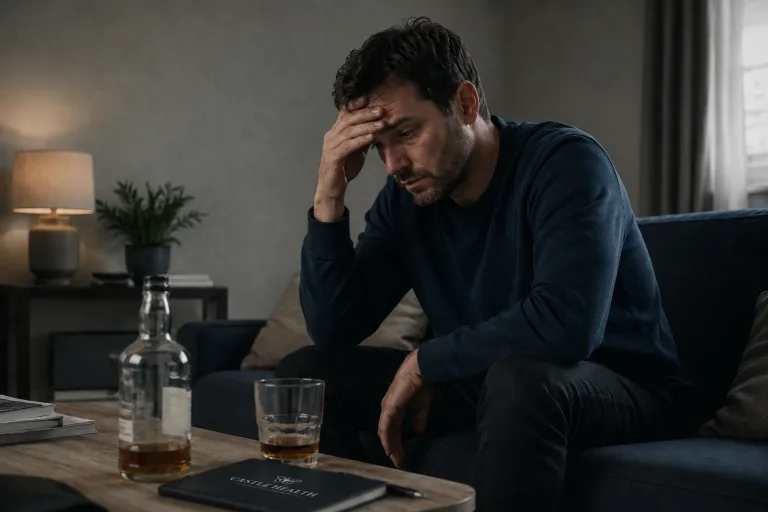
If someone in your life needs help with depression and addiction
Helping someone you know with depression and alcohol problems can be hard. Not knowing what to say, or whether to say anything at all, can hold us back.
You don’t need to have worked out what to say before getting in touch. Our team can speak with family members, partners, and friends, even if the person you are concerned about isn’t ready to ask for help themselves

How to talk to someone about depression and substance use
There is no perfect script for this conversation. But a few things tend to help:
- Choose a calm moment, not during or just after an argument, or when the person has been taking the substance
- Talk about what you have noticed, rather than what you think they should do
- Ask open questions
- Try not to lead with blame, even if you are feeling frustrated
- Suggest speaking to someone professionally, and offer to help with that step
One conversation rarely decides things. Planting the idea, calmly and without pressure, is often more impactful than first expected.
Support for families during treatment
Addiction has been described as a family illness, because of the way it erodes trust and communication over time. Family involvement has become a key part of how we work.
At Castle Health, family therapy and family support workshops are available as part of treatment. These help family members understand addiction as a health condition and build a foundation that supports their own well-being alongside the person in treatment. Workshops take place online and are included within treatment costs.
For more details on what family support looks like, speak to our admissions team when you get in touch.
Success Stories
We’ve helped many people turn their lives around
Get help today
Take the first step in your recovery journey
We are here to listen, guide and help you every step of the way. Call us today and together we can find a solution that suits you.
Our admissions process is confidential and designed to suit and support you and your circumstances. Find out more about the Admissions process.
Telephone
From the UK: 0131 287 4071
International: +44 (131) 287 4071
Frequently asked questions about depression and addiction
Can depression make addiction harder to recover from?
Yes it can. Depression affects motivation and sleep, two things directly involved in sustaining recovery. Low mood can also make coping without substances feel harder in the early weeks of treatment.
But the good news is that treatment can be adapted around this. At Castle Health, our clinical team assesses both conditions and builds a plan that accounts for the interaction between them.
Can alcohol or drugs cause depression symptoms?
Research published in Addiction found that having an alcohol use disorder roughly doubles the risk of developing major depression, and that the causal direction is more likely to run from alcohol use to depression rather than the reverse. Over time, alcohol changes the brain in ways that make mood disorders more likely.
Other research from Acta Psychiatrica Scandinavica also showed that heavy alcohol use can produce depressive symptoms. These closely resemble major depressive disorder, though these symptoms often improve with abstinence. Drug use can have similar effects.
Do I need residential treatment for depression and addiction?
Not necessarily. It depends on several things. The severity of your substance use, whether medical withdrawal support is needed, how much your mood is affecting daily functioning, the stability of your home environment, and how much support you have around you.
Our assessment process is designed to help answer this question for you specifically. Some people benefit most from residential treatment; others do well with outpatient or online support.
Can Castle Health treat depression on its own?
Castle Health doesn’t currently offer standalone residential depression treatment. Our residential programmes are designed for people with addiction, including those where depression is a co-occurring condition.
If depression is your primary concern, we can support a referral to an appropriate psychiatric service. If depression and addiction are both present, we can provide integrated assessment and treatment. Our admissions team can talk through which applies to you.
What happens if I am not sure whether I have depression, addiction, or both?
This is a very common position to be in. Many people who contact us aren’t sure what is happening, only that something does not feel right.
A proper assessment can clarify what’s happening and what kind of support makes sense. Contact our admissions team for a confidential conversation.