



Page last updated
Monday 7th Sep 2026

Page written by
Victoria McCann, Communications Director

Clinically reviewed on 26th August 2026 by
Ralf Warren, General Practitioner
Benzodiazepine prescriptions for anxiety or insomnia can be common across Europe. They can be very effective, but they are only designed for short-term use and with careful guardrails in place to try and prevent dependence forming.
One study of more than 100,000 patients in Catalonia found that over a quarter of people prescribed benzodiazepines took them beyond the recommended timeframe. Research across Sweden notes a similar pattern, particularly among older adults.
But, benzodiazepine addiction can develop even when medication is taken as directed. Understanding how this happens and the risks it presents is the first step in protecting yourself or someone close to you.

Get the support you need for benzodiazepine dependence




"I contacted Castle Health [formerly CATCH Recovery] seeking guidance and options to support a relative who was having a difficult time both with addiction and other mental health concerns. The team were incredibly kind and informed. They took the time to go through all the options with me and helped us plan how to approach the matter. Fortunately the person has now been receiving care for several months and is doing really well. I would highly recommend this service."

Benzodiazepine addiction: understanding your treatment options
What are benzodiazepines?
Benzodiazepines are a class of prescribed medication that reduces anxiety, aids sleep, and has several other clinical uses. Doctors prescribe them for anxiety, insomnia, seizures, and alcohol withdrawal.
They work by enhancing the effect of a brain chemical that slows nerve activity and produces a calming effect – something called gamma-aminobutyric acid (GABA).
Research published in 2025 found that 72% of participants in a study who regularly used opioids or other stimulant drugs reported benzodiazepine use. Non-prescribed use was the most common, particularly among younger adults.
Clinical guidelines recommend keeping use short. Typically, no more than four weeks for insomnia and up to 12 weeks for anxiety. Research published in Frontiers in Psychiatry found that benzodiazepines are among the most widely used treatments for chronic insomnia, and are frequently used for longer than their recommended duration.

Common types of benzodiazepines
The most commonly prescribed benzodiazepines include:
- Diazepam (Valium) – used for anxiety, muscle spasm, and alcohol withdrawal. Long-acting.
- Lorazepam (Ativan) – used for anxiety and seizures. Intermediate-acting.
- Alprazolam (Xanax) – used for anxiety and panic disorder. Intermediate-acting.
- Clonazepam (Klonopin) – used for panic disorder and seizures. Long-acting.
- Temazepam – used for short-term insomnia. Short-acting.
Short-acting benzodiazepines clear the body faster, producing more intense withdrawal and a generally higher dependence risk.
The European Union Drugs Agency (EUDA) provides a comprehensive overview of benzodiazepine use and risk patterns across Europe.
How does benzodiazepine addiction develop?
Benzodiazepines change the way the brain processes anxiety and calm. With prolonged use, the brain adjusts to the presence of the medication, and begins to rely on it to maintain a baseline level of functioning. This is called tolerance.
As tolerance builds, the original dose produces less effect over time. Even stopping briefly can produce anxiety or physical discomfort that can be worse than the original feeling.
This can happen even when medication is taken exactly as prescribed. There is a recommendation of diazepam to be given for no more than four weeks because dependence can develop within that window.
Difficulty stopping is a physical response. The brain has adapted to the drug’s presence and needs time and support to readjust.
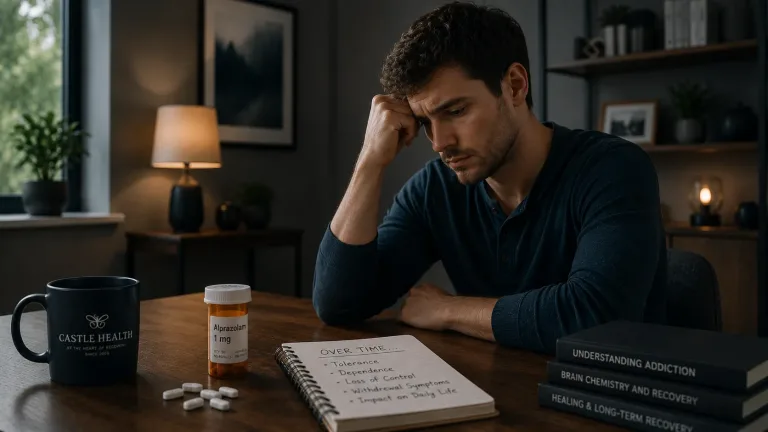
The difference between benzodiazepine dependence and addiction
These two terms are often used interchangeably, but they describe different things.
The American Psychiatric Association notes that dependence can be a normal body response that doesn’t indicate addiction on its own. Physical dependence means the body has adapted to a substance and will produce withdrawal symptoms if it is stopped. That process can happen even when medication is taken responsibly.
The ICD-11 describes dependence as a pattern that develops through repeated use. Key features include a strong urge to use the substance and increasing difficulty putting other things first.
Addiction is defined by compulsive use despite harm. Physical dependence, tolerance and withdrawal can exist without these behavioural features.
Both situations benefit from an accurate clinical assessment and finding the right level of care.
Signs and symptoms of benzodiazepine addiction
The signs of benzodiazepine dependence can be difficult to recognise, especially if you were prescribed the drugs for a real medical need. Individual signs are easy to explain away, but a pattern across several areas is harder to dismiss.
Behavioural signs of benzodiazepine addiction
- Requesting prescription refills earlier than expected
- Visiting more than one GP to obtain prescriptions (sometimes called doctor shopping)
- Becoming secretive about how much medication is being taken
- Withdrawing from relationships or social situations
- Neglecting work, family responsibilities, or other commitments
- Obtaining benzodiazepines outside of a prescription, including online or informally
Psychological signs of benzodiazepine addiction
- Anxiety or panic when medication is running low or unavailable
- Using benzodiazepines to manage everyday stress rather than as prescribed
- Preoccupation with the next dose or with ensuring supply
- Mood changes, including irritability, low mood, or emotional flatness
- A sense that normal functioning requires the medication
- Needing to take a higher dose of the medication to get the same effects, or building a tolerance
- Difficulty imagining managing difficult situations without it
- Being unable to stop using benzodiazepines, despite knowing the harms or making previous attempts to do so
For people originally prescribed benzodiazepines for anxiety, the original condition and withdrawal can feel identical.
Physical signs of benzodiazepine use
- Drowsiness or sedation outside of typical sleep hours
- Slurred speech
- Poor coordination or unsteadiness
- Memory lapses, particularly around events shortly after taking medication
- Confusion or difficulty concentrating
- Headaches, nausea, heightened anxiety, sweating or tremours, particularly when a dose is delayed. These symptoms are common features of benzodiazepine withdrawal
If you spot any of these physical signs, especially when you’ve been unable to cut down, you should speak to a medical or addiction professional.
The health risks of long-term benzodiazepine use
Long-term benzodiazepine use is associated with several well-documented health risks:
- Cognitive effects: memory impairment and reduced processing speed are associated with prolonged use.
- Depression: extended use has been linked to depressive symptoms, and may increase the occurrence of intrusive thoughts and risk of suicide
- Paradoxical anxiety: long-term use can increase rather than reduce anxiety in some people.
- Falls and injury risk: benzodiazepines affect coordination and reaction time, creating particular risk for older adults who are more likely to sustain bone fractures or head injury and require hospital admission as a result.
The risk of mixing benzodiazepines with other substances is especially serious. Combining benzodiazepines with alcohol or opioids raises overdose risk substantially, even at doses that wouldn’t be dangerous on their own.
According to the EUDA’s European Drug Report, in 2023, benzodiazepines were detected in the majority of overdose deaths in Denmark, Austria, Slovenia, and Finland. Alcohol also appeared frequently in those cases. In those four countries, benzodiazepines were associated with more than half of all drug-induced deaths in 2023.
If you, or someone in your life, is using benzodiazepines alongside alcohol or other medication, it warrants urgent medical attention.
Benzodiazepine dependence and co-occurring conditions
Anxiety disorders and insomnia in particular are among the conditions that most commonly lead to a benzodiazepine prescription. But those same conditions can complicate the picture when dependence develops.
High-potency benzodiazepines are frequently prescribed for panic disorder because of their rapid onset. The relief they provide can become something the nervous system relies on, rather than addressing underlying anxiety directly.
Research into chronic insomnia also highlights that when alternatives such as Cognitive Behavioural Therapy for insomnia (CBTi) are not available, benzodiazepines tend to be used for longer than recommended.
Stopping benzodiazepines without addressing the underlying condition often means the original symptoms return. Treatment that tackles both gives the best chance of lasting recovery.
Is benzodiazepine addiction different if it started with a prescription?
Developing benzodiazepine dependence through a legitimate prescription is a medical situation. You haven’t done anything wrong, and you deserve the same level of care as with any other health issue.
The American Psychiatric Association acknowledges that physical dependence can be a normal bodily response to a substance, regardless of how the medication was obtained.
Many people feel confused and embarrassed about becoming dependent on something their doctor gave them. But prescription-route dependence is a recognised medical situation with established treatment pathways.
Starting a conversation, whether with your GP or with our admissions team, doesn’t commit you to anything. For broader context, our prescription drug addiction page has more detail on what treatment involves.

Locations designed to support your recovery






Getting help for benzodiazepine addiction
Stopping benzodiazepines without medical supervision carries risk. Withdrawal can produce serious symptoms, including seizures. In cases of long-term or high-dose use, abrupt withdrawal can be life-threatening. Knowing that risk is precisely the reason to seek proper support rather than attempt it alone.
Treatment usually starts with a managed detox, where the dose is reduced gradually under medical supervision. This is followed by therapy that addresses both the dependence and, if needed, the conditions behind the original prescription.
Some people also experience a longer recovery period – weeks to months of persistent low-level anxiety, poor sleep, or difficulty concentrating – as the brain continues to adjust beyond the acute withdrawal phase.
Our benzodiazepine addiction treatment page has full details on what that process involves.
Castle Health’s inpatient treatment programme includes medical detox, individual and group therapy, and a continuing care plan designed to support recovery beyond the residential phase.
Recovery Hub
Discover what else we’re talking about



If someone in your life has concerns about their benzodiazepine use
Addiction affects the people around the person, too. Watching someone you care about change, without knowing whether it’s medication-related or something more, is really tough. Benzodiazepine dependence doesn’t always look like a conventional addiction. The person may be dismissing the problem, pointing to the fact that a doctor prescribed it.
You don’t need a diagnosis to reach out. Our admissions team speaks with families regularly, and we can help you make sense of what you’re seeing and how best to raise it.
Castle Health offers family therapy as part of our treatment programme. We also support interventions when families are helping someone take a first step. Castle Health’s care extends to everyone who’s been impacted.
Get help today
Take the first step in your recovery journey
We are here to listen, guide and help you every step of the way. Call us today and together we can find a solution that suits you.
Our admissions process is confidential and designed to suit and support you and your circumstances. Find out more about the Admissions process.
Telephone
From the UK: 0131 287 4071
International: +44 (131) 287 4071
Care to the highest standards
Committed to quality care
Frequently asked questions about benzodiazepine addiction
Can I become dependent on benzodiazepines if I take them exactly as prescribed?
Physical dependence can develop even when medication is taken exactly as directed. There is general advice that diazepam be given for no more than four weeks partly because of this risk. The APA defines dependence as a physiological adaptation that does not, by itself, indicate addiction. If you have concerns about your current use, speaking to your GP is a sensible first step.
How long does it take to become dependent on benzodiazepines?
NHS clinical guidance recommends benzodiazepines for no longer than four weeks, because dependence can develop within that window. Some clinical sources put the risk earlier – two to four weeks of daily use in some cases. Ongoing prescriptions should be reviewed regularly with a GP.
Are some benzodiazepines more addictive than others?
Short-acting benzodiazepines, such as alprazolam (Xanax), generally carry a higher risk of dependence developing quickly. They leave the body faster, creating more pronounced drops in concentration between doses. Long-acting options, such as diazepam (Valium), produce more gradual changes so are sometimes used in supervised tapering programmes.
Can benzodiazepine dependence affect my mental health long-term?
Long-term use is associated with cognitive effects including memory impairment and reduced processing speed. Extended use has also been linked to depression. Some people find their anxiety worsens over time rather than improving – a pattern known as paradoxical anxiety. For some people, cognitive effects improve after stopping. The evidence on full recovery is mixed, and improvements depend on how long and how heavily the medication was used.
Is it possible to overdose on benzodiazepines alone?
Yes, though the risk increases substantially when benzodiazepines are combined with other substances. According to the EUDA’s European Drug Report 2025, in 2023, benzodiazepines were detected in the majority of overdose deaths in Denmark, Austria, Slovenia, and Finland. Alcohol was also frequently identified, and opioids also increase the risk. If you’re taking benzodiazepines alongside alcohol or other CNS depressants, seek medical advice.
What is the difference between a benzo taper and stopping cold turkey?
A medically managed taper reduces the dose gradually, giving the nervous system time to adjust. For long-term users, a full taper can take months, and many protocols begin by switching to a longer-acting benzodiazepine such as diazepam before the dose is reduced. Stopping suddenly can trigger severe withdrawal, including seizures, so a supervised reduction is almost always safer. Our benzodiazepine addiction treatment page covers how this works in practice.
Are benzodiazepines legal to buy online or without a prescription in Europe?
Benzodiazepines are prescription-only medicines across most of Europe and cannot be legally purchased without one. Online pharmacies operating outside proper regulation sometimes supply them without a prescription. That is both illegal and carries serious safety risk. Research published in 2026 found that non-prescribed benzodiazepine use was linked to younger age and higher-risk behaviours in drug-using populations.