For a long time, addiction was considered to be a moral failing, a lack of willpower, or even a choice in lifestyle. Research over the past few decades, however, has changed our understanding.
We now know it alters the brain’s structure and function. It affects the decision-making ability of a person, and it compels certain behaviours in a person that go beyond what someone chooses.
This led to the disease model of addiction which, today, is one of the most clinically supported frameworks we have for explaining why addiction develops, why it’s hard to stop, but also why it can respond so well to treatment.
What is the disease model of addiction?
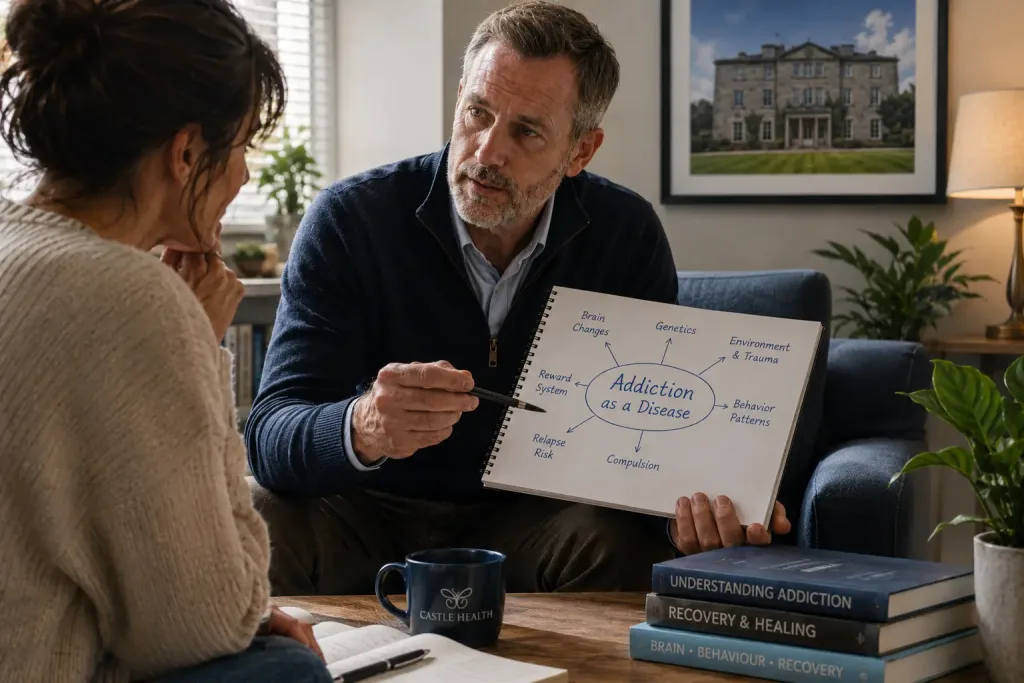
The brain disease model of addiction describes it as a chronic brain condition. It recognises that repeated exposure to alcohol or other substances changes the brain in measurable, lasting ways. These changes affect how a person experiences pleasure, makes decisions, and responds to stress.
Understanding the addiction disease model means approaching it the way we approach other chronic conditions.
Someone with type 2 diabetes doesn’t simply choose to stop needing insulin, and a person living with addiction doesn’t simply choose to stop the cycle of compulsion through willpower alone.
Why addiction is considered a disease
A disease, in medical terms, is an abnormal condition that harms the body or mind and stops it from working normally. Addiction meets this definition.
Brain imaging studies show measurable changes in the brain’s reward, decision-making, and impulse control regions. This is referenced in the Royal College of Psychiatrists’ guidance. These changes are well-documented and help to strengthen the debate about the disease model of addiction.
Brain changes and addiction
When someone uses alcohol or other drugs repeatedly, the brain’s reward system begins to change & adapt. The surge of dopamine that makes a substance feel rewarding gradually diminishes with repeated use. The brain recalibrates. What once felt pleasurable now simply feels like relief. Or a return to a baseline that has dropped well below where it started.
Three parts of the brain can be particularly affected:
- The part that forms habits starts to treat taking in substances, or gambling, for example, as automatic, like reaching for your phone.
- The part that processes stress makes withdrawal feel unbearable.
- And the part that’s supposed to say stop becomes harder and harder to hear.
Many people with addiction can’t stop without clinical support. Not because of a lack of will, but because the brain’s decision-making architecture has changed.
Interested to know more about alcohol addiction?
The role of genetics and environment
Some gene variations appear more often in people who develop addiction, particularly those affecting how dopamine works. This raises the risk. It doesn’t make addiction certain in every person, however.
According to the Royal College of Psychiatrists, genetics influences our vulnerability to both addiction and mental health conditions. The two are often linked, and both help explain why some people are at greater risk than others.
Family history matters, but not only through genetics. Growing up around substance use, or in an environment with a history of trauma can raise the risk in some cases.
How the disease model changed treatment
Before the disease model took hold, addiction was seen as a matter of willpower or moral character. People were expected to stop through willpower, religious commitment, or legal consequence. Treatment, where it existed, was often punitive rather than clinical.
That shift changed what addiction treatment looked like:
- Medication became part of the picture for alcohol and opioid dependence
- Drugs like naltrexone and acamprosate help manage cravings for alcohol
- For opioids, buprenorphine is widely used to support stabilisation and reduce withdrawal symptoms
- Psychological therapies were developed specifically for addiction
- Relapse began to be understood as part of a clinical process, not evidence of weakness.
Cognitive Behavioural Therapy (CBT) is one of the most well-researched approaches available. It helps a person recognise the thoughts and situations that make using drugs more likely, and develop practical tools to respond differently. NICE guidelines recommend CBT for both drug misuse and alcohol dependence. It is now a core component of most evidence-based treatment programmes.
People who understand addiction as a disease are more likely to seek help and less likely to blame themselves for struggling.
Criticisms of the disease model
The disease model is the most widely accepted framework for understanding addiction in clinical practice. It’s not without critics.
Not everyone agrees. The neuroscientist Carl Hart argues that where someone lives, and how much hope they have, shapes addiction just as much as brain chemistry. His research suggests that when people in poverty are offered meaningful alternatives, rates of problematic drug use fall. His work doesn’t undermine the disease model. It asks us to look at the whole person, not just the brain.
No single model explains addiction for every person. The disease addiction model explained why recovery can be difficult, and it is the most well-evidenced starting point. It works best when it sits alongside an understanding of the whole person.
"I'm 5 years sober now and I know I wouldn't have survived another month before I joined the treatment programme. Castle Craig is an amazingly special place where miracles really do happen, I'm blessed to have found you."

Other models of addiction
The biopsychosocial model takes a broader view. It understands addiction as the product of biological factors, psychological history, and social context working together. Most addiction clinicians work within this framework. That’s why things like family therapy and trauma-informed care are built into treatment from the start.
The coping model, most associated with the physician and author Gabor Maté, understands substance use as a response to pain. In this view, the question isn’t why the addiction but why the pain. This perspective is particularly important in understanding addiction that develops alongside trauma, adverse childhood experiences, or untreated mental health conditions. It doesn’t contradict the disease model, rather it asks us to look further back.
At Castle Health, we don’t treat addiction as a single thing with a single explanation. The evidence tells us that multiple processes are usually in play. Our programmes are built to assess and address all of them.
What this means for recovery
If addiction is a chronic condition, recovery isn’t a single event that happens, and then we move on. It’s a process that unfolds over months and even years, with different challenges at different stages.
Relapse can be part of a recovery journey. Managing a chronic condition means responding to setbacks, not expecting a single treatment episode to resolve everything. There is no shame in relapse, either. It just means that how you are managing your recovery may need to change to suit you at the time, and help and support are available through our outpatient services or through your local support groups.
For many people, addiction develops alongside other mental health conditions such as depression, anxiety, or PTSD. These don’t always come after addiction. Often, they’re present beforehand, and substance use becomes a way of managing them. Effective treatment takes both into account.
What recovery does make possible, consistently and over time, is meaningful change:
- Relationships repair
- Physical health improves
- A sense of identity that’s not defined by the substance gradually re-emerges
None of this happens quickly, and seldom without support.
How Castle Health approaches addiction
At Castle Craig and Smarmore Castle, we treat addiction as a chronic condition. That means structured, evidence-based care. Our treatment also continues well beyond discharge, to support a person to build on what they have learnt during rehab.
Addiction is highly personal to you and your lifestyle, and other health factors. That’s why treatment won’t be the same for everyone. The pace, the methods, and the aftercare plan are all shaped by the individual and what they need.
Our residential programmes are built around CBT and trauma-informed therapy, alongside group work and family involvement.
We use a 12 Step framework as one of several evidence-based approaches, not as a single doctrine. Spiritual elements of 12 Step are available but not required.Aftercare is part of the treatment plan from day one. For many people, the period immediately following discharge carries the highest relapse risk. Our aftercare structure is designed to bridge that gap, with continued clinical support, access to our alumni network, and ongoing connection to our team.
If you want to understand what treatment involves, or whether it might be right for you or someone you care about, our team is here to talk. There’s no obligation and no pressure to decide anything immediately.

Frequently asked questions about the disease model of addiction
Does the disease model remove responsibility?
No. The model changes what we expect of people in recovery, not who is doing the work. Someone with addiction still makes choices every day that support or undermine their recovery. What it challenges is the idea that willpower alone should have been enough.
Are there other ways to understand addiction?
Yes. The biopsychosocial model understands addiction as the product of biology, psychology, and social context together. The coping model, associated with Gabor Maté’s work, focuses on the role of pain and trauma in driving substance use. Most clinicians draw on more than one framework. The disease model provides the clinical foundation. These other models ensure we look at the whole person, not just the diagnosis.
How does this affect treatment?
The weeks after stopping a substance mark the beginning of something, not the end of a process. Recovery builds from there. Effective rehab treatment addresses the psychological and social dimensions of addiction alongside the neurological. It includes structured therapy, medical support where appropriate, and a plan for what comes after the residential phase. It takes time, and it needs to be supported over time.