



Page last updated
Monday 21st Sep 2026

Page written by
Victoria McCann, Communications Director
If nothing has worked so far, that’s clinically useful information. It points toward what kind of condition porn addiction is, and what kind of treatment it actually requires.
Compulsive pornography use is classified in the ICD-11 under Compulsive Sexual Behaviour Disorder. It is a recognised condition with recognised treatment pathways, and one that responds to the same evidence-based clinical approach that Castle Health applies across both behavioural and substance addiction.
Treatment is built around the individual; their history, the function the behaviour has come to serve, and what recovery needs to look like within the context of the rest of their life.

porn addiction support
Get the support you need for porn addiction
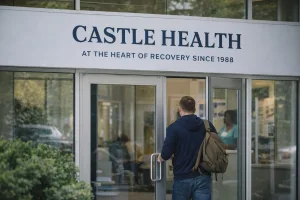


Porn addiction treatment options: outpatient, residential and online care
Whilst some people looking at treatment for porn addiction need residential care, most don’t. Here’s what each pathway involves, and how to tell the difference.

Outpatient treatment for porn addiction
Outpatient treatment for porn addiction means you live at home and attend therapy on a structured schedule. A study in the Journal of Behavioral Addictions followed 72 patients in outpatient treatment for compulsive sexual behaviours. Most improved measurably across a median of four weeks/six sessions. Not everyone responds in a month, but outpatient treatment for behavioural addictions has a documented evidence base.
For treatment for porn addiction, this is often the right place to start. There is no physical detox involved, and the work itself – recognising urges and rebuilding the routines around them – is practised in your actual life rather than away from it.
The pace of a typical outpatient week is set by you. It can include one to three sessions, usually a mix of individual therapy and group work, with reflection and practice in between.
Residential treatment for porn addiction
Residential treatment means you stay with us for a defined period, usually a number of weeks, with 24-hour access to clinical staff and a full daily programme. It is more intensive than outpatient care and, for most people considering treatment for porn addiction, it isn’t the first step.
Our residential treatment for porn addiction is delivered at Smarmore Castle in Ireland and Castle Craig in Scotland. Both centres treat behavioural and substance addictions side by side – the two are often connected in the people we see, and treating them together is more straightforward in a residential setting.
Residential treatment is best when:
- Addiction sits alongside a substance addiction, alcohol or drugs, that needs medical input
- There is significant co-occurring depression or trauma that benefits from a contained environment, or
- The home environment itself, for whatever reason, makes outpatient work very difficult to sustain.
We’ll say if residential isn’t what you need for porn addiction treatment – it isn’t always the right starting point for everyone.
Online treatment for porn addiction
Online treatment for porn addiction consists of therapy delivered remotely, by the same clinical team. For porn addiction specifically, it has clear advantages. Privacy matters more here than in most conditions, and treatment fits around work and family commitments. Recovery coaching sits inside this offer too.
It’s a less intensive form of one-to-one support that works well as a continuation of treatment, or as a starting point for people who aren’t yet ready for residential porn addiction treatment.
How do I know which type of treatment for porn addiction is right for me?
There’s no firm rules for which type of porn addiction treatment is right for you, but there are things to consider which might help guide you:
- You’ve tried to stop on your own, and found it hasn’t held
- Your current home or work environment is it part of what makes stopping difficult
- You’re also drinking heavily, or living with depression
- How much privacy you have for treatment, and how much you need
If your home life is stable and there are no significant co-occurring conditions, outpatient treatment is usually the right place to start.
If a substance addiction or serious co-occurring mental health condition is in the picture, residential treatment is worth discussing.
If privacy or geography is the main constraint, online treatment is built for exactly that.
“I contacted Castle Health [formerly CATCH Recovery] with a view to getting online support after a period in rehab. They recommended recovery coaching and arranged for me to meet my coach in person as the first of 10 meetings. I continued the coaching on Zoom as I live in France. I was very happy with my 10 sessions and feel I am in a good place to continue my recovery.”

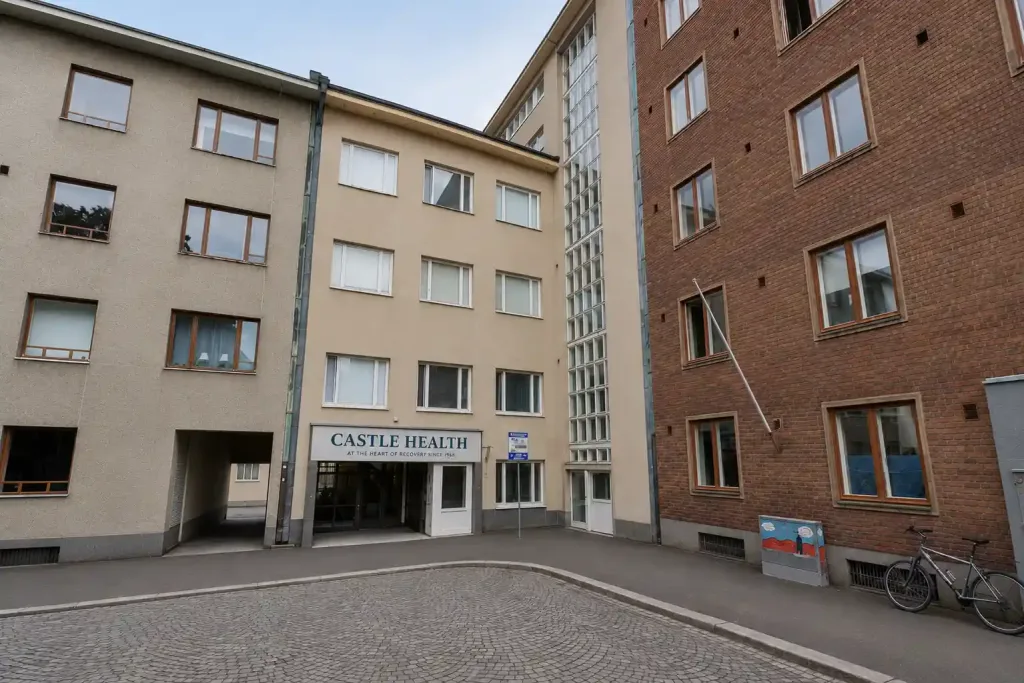
Locations designed to support your porn addiction recovery


The therapies used in treatment for porn addiction, and why they work
Most providers will list the therapies used in treatment for porn addiction. Few explain why each one is suited to this particular condition. Porn addiction is sustained by a specific loop:
Urge → behaviour → shame → isolation.
Each type of therapy addresses a part of this loop, directly.
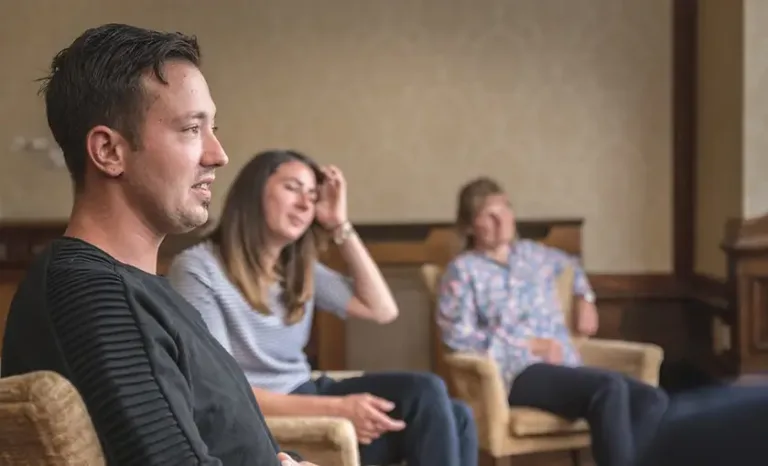
Cognitive and Dialectical Behavioural Therapy (CBT and DBT)
Cognitive Behavioural Therapy (CBT) is the therapy with the strongest evidence base for behavioural addictions. Porn addiction is a learned behaviour, and CBT treats it as something that can be unlearned, so it’s one of the most effective approaches for behavioural addictions.
It maps the cycle – the state that leads to the behaviour, the trigger, the behaviour itself, and what happens after – then breaks the cycle at the point where it is most workable.
A typical course is time-limited and moves through two phases: changing the behaviour, then changing the thinking around it. Dialectical Behavioural Therapy (DBT) is closely related. It’s particularly useful where the urge to view porn is bound up with difficulty tolerating distress.
Group therapy
Group therapy puts you, in person or online, with other people working on the same thing. Isolation sustains porn addiction, and shame sustains isolation.
That loop usually breaks the moment someone else describes their own version of it. Group work tends to form part of every treatment programme we run.
Couples and family therapy
Where a relationship is involved, couples therapy is often part of the treatment plan, either alongside individual work or as a follow-on. Two journals have published case work on this. The Journal of Couple & Relationship Therapy shows structural therapy can work for couples affected by pornography use. A paper in the Journal of Marital and Family Therapy sets out how family therapy supports recovery. For more on this part of treatment see our couples therapy in treatment for porn addiction page.
12 Step facilitation
12 Step is part of Castle Health’s heritage and remains part of how we work. For porn addiction, the most relevant 12 Step community is Sex Addicts Anonymous (SAA). It operates in around 42 countries. The structure mirrors the original Alcoholics Anonymous model: a defined sequence of steps worked through with a sponsor.
Evidence that 12 Step participation is associated with better outcomes for compulsive sexual behaviour comes from studies that found progress through the programme was linked to lower compulsivity and higher reported wellbeing. We use 12 Step as one tool among several, and we treat it as part of the long-term picture rather than the programme itself.
See our types of therapy page for the full picture.
What to expect from porn addiction treatment with Castle Health
Treatment with us follows a clear sequence. Each stage prepares for the next, with the same clinical team throughout.
Initial conversation
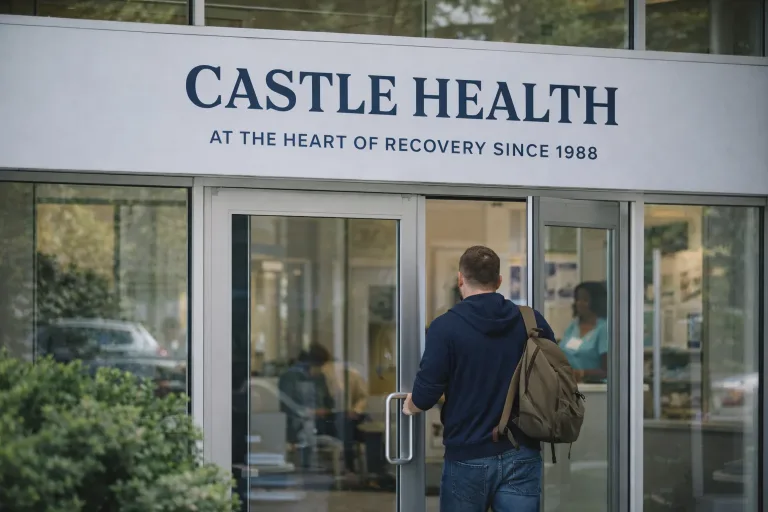
The first contact is an informal conversation. You can call or message us, with no commitment, and speak in confidence to someone on our admissions team. There, we’ll try to understand what’s going on for you and talk through a sensible next step.
If treatment with us is the right move, we’ll tell you so. If you’d be better served by something else, we’ll tell you that too.
Where residential treatment is the right next step, we’re often able to admit within 48 hours. Outpatient and online programmes typically begin within the same week.
Clinical assessment
If you decide to go ahead, a clinical assessment confirms the right pathway. The assessment looks at:
- How often the behaviour is happening, and how it’s changed over time
- The impact on your relationships and day-to-day functioning
- Whether alcohol or drug use is also in the picture, and any co-occurring mental health conditions such as depression, trauma, ADHD or OCD
- Any previous attempts at treatment, and what happened with them
- The privacy you have available for treatment, and the privacy you need
The assessment is also where you ask the questions you came in with. It isn’t a one-way interview.
Therapy
This is the main body of the work. Whether you’re seen as an outpatient, residentially, or online, the therapeutic approach is the same: time-limited, and built around the specific loop sustaining the behaviour. Sessions are a mix of one-to-one and group work, with reflection and practice in between.
Where it’s clinically indicated, medication may be considered alongside therapy as part of an individual treatment plan. This is decided in the clinical assessment, not assumed. Most people in treatment for porn addiction don’t need medication; for those who do, it’s usually to support a co-occurring condition.
Compulsive sexual behaviour, the clinical category porn addiction sits within, is one of the conditions Castle Health treats most often. You won’t need to explain what it is to us, or why it’s been hard to stop on your own.
Aftercare
Leaving structured treatment is its own transition. The work shifts from getting the behaviour under control to keeping it there as ordinary life resumes – the same triggers, the same private moments alone with a screen.
Aftercare is how we stay with you through that. It includes regular check-ins with your clinical team and a relapse prevention plan worked out in the closing weeks of treatment. Where it suits you, recovery coaching or a 12 Step community provides a longer-term scaffold.
For most people, aftercare lasts longer than the formal treatment that precedes it. That’s by design.
PAYING FOR YOUR TREATMENT
Costs and payment options for porn addiction treatment
Castle Health works with a wide range of UK and European health insurance providers. We also accept self-paying patients directly, and NHS referrals where eligible. Outpatient and online care are less expensive than residential treatment, and most people find that some combination of routes works for them in practice. The admissions team will walk you through the figures in the first conversation, so you have clear numbers before any decision.
If someone you know needs help with porn addiction
If you’re on this page on behalf of someone in your life – a partner, a child, a close friend – what you’re feeling is reasonable.
There’s hurt, often a sense of betrayal, and confusion about what the behaviour means and what it doesn’t. None of that needs to be resolved before help becomes possible.
Porn addiction is a recognised, treatable condition. Most people who reach treatment do so because someone close to them pointed them toward it. You’re not interfering. Looking into this is often the part that has to come first.
If there’s any concern about safety – your own, or the person you’re worried for – the admissions team is the right first call..
How to start the conversation depends on the relationship and the moment, but considering a few things tend to help:
- Choose a time when neither of you is tired
- Speak about what you’ve noticed rather than what you think they should do
- The goal is treatment, not confrontation
- You don’t have to have all the answers before reaching out
Our admissions team will speak to family members as readily as to the person directly.
Where the situation is more difficult – the person isn’t yet open to treatment, or earlier conversations haven’t held – we can also help you organise an intervention.
Family and couples therapy is part of what we offer, and is often used alongside the individual work. Research on internet addiction, a related behavioural addiction, has tested family-based therapy. It reduced the severity of the addiction more than no intervention, and worked best alongside other treatments.
If you’d like to read more about this part of our work, see our couples therapy in treatment for porn addiction page, and porn addiction and mental health.
Success Stories
We’ve helped many people turn their lives around
Get help today
Take the first step in your recovery journey
We are here to listen, guide and help you every step of the way. Call us today and together we can find a solution that suits you.
Our admissions process is confidential and designed to suit and support you and your circumstances. Find out more about the Admissions process.
Telephone
From the UK: 0131 287 4071
International: +44 (131) 287 4071
Care to the highest standards
Committed to quality care
Frequently asked questions about porn addiction treatment
How long does treatment for porn addiction usually last?
It depends on the pathway. The median in published outpatient research is six sessions, although many people stay in treatment longer. Residential treatment is typically measured in weeks of inpatient stay followed by ongoing outpatient or online support. Online treatment fits around your schedule. The first conversation with our admissions team will give you a realistic timeframe for your situation.
Is porn addiction treatment confidential? Will my employer or family find out?
Treatment with us is confidential. Your employer isn’t told, and your family isn’t told, unless you choose otherwise. Online treatment exists in part for this reason and removes most of the practical privacy concerns people raise.
Can I have treatment for porn addiction if I’m also dealing with alcohol or drug use?
Yes. Treating a behavioural addiction alongside a substance addiction is something Castle Health does often. When both are in the picture, residential treatment is more likely to be the right starting point, because a substance addiction may need medical input that outpatient care can’t provide. The first conversation will clarify which pathway makes sense.
Does treatment for porn addiction include partner involvement, or is it just for me?
Both options exist. Treatment can be entirely individual, or it can include couples or family therapy alongside individual work. Where a relationship has been affected, partner involvement is often useful, but it’s your decision and your partner’s, not ours.
What does treatment for porn addiction cost?
Cost depends on the pathway. Outpatient and online care are less expensive than residential treatment. See Costs and payment options for the full picture, including insurance and NHS routes. The admissions team will walk you through the specific figures for your situation in the first conversation.