
United Kingdom
Castle Craig, Scotland
Find out more

All relationships go through difficult periods, and when addiction is involved, those challenges can feel harder to navigate. Couples therapy can help by providing you with support from a couples therapist who understands both relationships and recovery.
At Castle Health, we offer couples therapy in the UK and across Europe because we know that the people around you matter as much as the work you do on your own.

Couples therapy is a form of talking therapy where both partners meet regularly with a trained therapist to work through difficulties in their relationship. Their role is not to take sides or decide who is right, but to help both of you understand what is happening between you and find more constructive ways to communicate and move forward.
Your couples therapist will guide the conversation, but both partners have equal space to speak and be heard. Couples therapy can help with a wide range of difficulties, including breakdown in communication, loss of trust, emotional distance, the strain of parenting together, and the specific pressures that addiction places on a relationship.

Couples therapy isn’t a last resort, and for many people it’s a proactive choice, and a way to invest in something they care about before small tensions become difficult to handle. People also come to us when they feel stuck in certain patterns and aren’t sure how to move forward on their own.
Here are some of the main reasons couples decide to seek therapy alongside rehab treatment:
Communication problems are the most common reason couples seek therapy. When conversations often end in confusion, fights, or one partner pulling away, it can feel difficult to amend without the help of a professional.
In therapy, a couples therapist helps both partners identify the patterns driving those conversations and practise more constructive ways of communicating, including listening without interrupting, expressing needs clearly, and managing conflict without it escalating.
Rebuilding trust after infidelity or breaking trust takes time and effort from both partners. In therapy, both partners have space to talk about what happened and what each needs going forward.
When addiction is involved, trust may also have been damaged by secrecy, broken promises, or unpredictable behaviour during active use. Therapy gives both partners a space to address that honestly, at a pace that works for them.
Disagreements about parenting often cause stress, especially about discipline, daily routines, and sharing duties. When addiction is part of family life, parenting tasks and money problems often aren’t shared fairly, which can lead to one partner feeling resentful.
Couples therapy gives both partners a structured space to talk about what is and is not working at home, and to reach practical agreements about how to share responsibilities more fairly going forward.
Emotional distance is often difficult to address without support because neither partner always knows where to start. In therapy, both partners work with the therapist to understand what has driven the distance and how to reconnect.
For couples dealing with addiction, this often means looking at how the relationship changed during active use and what rebuilding closeness looks like now that recovery has started.
LGBTQ+ couples can face challenges that others don’t, including the impact of discrimination, navigating family relationships that may not be accepted, and managing the effects this has on mental health. When addiction is also present, these pressures can intensify.
“I contacted Castle Health [formerly CATCH Recovery] with a view to getting online support after a period in rehab. They […] arranged for me to meet my coach in person as the first of 10 meetings. I continued the coaching on Zoom as I live in France. I was very happy with my 10 sessions and feel I am in a good place to continue my recovery.”

Couples therapy at Castle Health is offered alongside our outpatient program, so it can happen at the same time as individual addiction treatment instead of waiting until treatment is finished.
Sessions are available in person at our clinics or online, usually once a week, and we can organise both joint and individual sessions.
Our therapists are accredited and have specific experience in both addiction and relationship therapy. The approaches we use include:
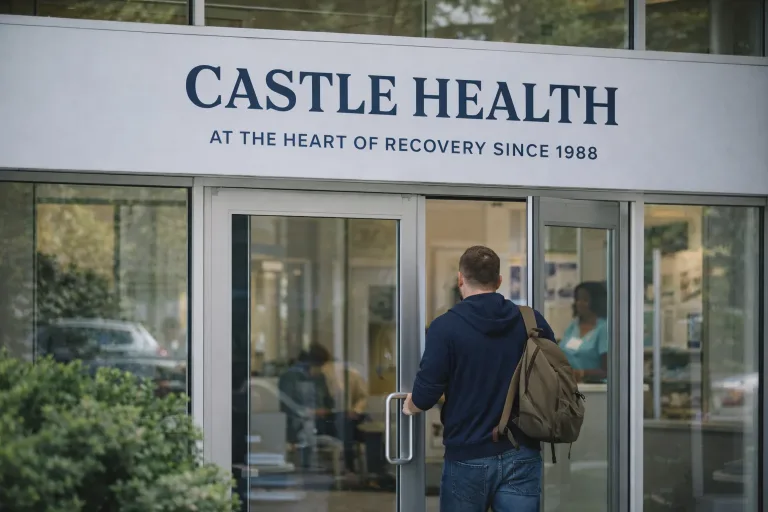

Each session lasts about an hour and usually happens weekly. In the first sessions, the therapist will take time to understand the relationship, why you came to therapy, and what each partner hopes to get from it.
As sessions continue, the focus moves to practical skills such as:

Relapse prevention is part of every addiction treatment program at Castle Health. In couples therapy, this means both partners learn to spot early signs of relapse together and create shared ways to handle the situation.
Research shows that problems in a relationship are one of the strongest signs that relapse might happen, and couples who know each other’s triggers and have a clear plan for tough times usually do much better in the long run than those who face these moments alone.
This doesn’t mean one partner is responsible for the other’s sobriety. Recovery is still a personal journey. Couples therapy provides tools to support that journey together, so no one has to carry a burden that was never theirs alone.
Couples therapy works best when both partners are willing to engage with the process, but that doesn’t mean both people have to feel equally ready from the start. It’s common for one partner to be more hesitant. That said, the couples who come to us, whatever their reservations, are here because they want things to be better.
If you have any questions, our team is always here to talk and can walk you through what couples therapy at Castle Health involves.

Online couples therapy provides the same setup and quality of care as face-to-face sessions. Both partners join a private video call with their therapist, and the sessions follow the same steps as they would in a clinic.
People choose online couples therapy for a variety of reasons, whether that’s work schedules, childcare, distance from one of our clinics, or simply a preference for being at home. Whatever brings you to it, the support you receive is the same.
We are here to listen, guide and help you every step of the way. Call us today and together we can find a solution that suits you.
Our admissions process is confidential and designed to suit and support you and your circumstances. Find out more about the Admissions process.
From the UK: 020 3098 2503
International: +44 (20) 3098 2503

Whether something works or not depends on whether both partners are willing to engage openly with the process.
It’s common for one partner to feel unsure. You can speak to a therapist on your own first to get some support and think through how to approach the conversation at home. Sometimes that first step makes it easier for a hesitant partner to come on board when they feel less pressured.
Therapy gives couples a space to have honest conversations and to try to gain a new perspective on their relationship. In some cases, it helps couples reconnect. In others, it helps them navigate a separation more clearly, particularly where children or finances are involved. What it offers in either case is clarity.
The first session is largely about your therapist getting to know you both and understanding what has brought you to therapy. You do not need to prepare anything in advance.
Couples therapy is not limited to married couples. It is open to partners at any stage of a relationship, whether married, cohabiting, dating, or navigating a separation. It’s also not limited to heterosexual couples. Our therapists work with couples of all identities, orientations, and relationship structures and tailor the approach to your specific situation rather than a fixed idea of what a relationship should look like.
The cost depends on how much support you need and whether sessions are in person or online. In the UK, couples therapy usually costs between £500 and £1,000 for about five sessions. At Castle Health, we discuss costs with you personally before you decide. You can pay privately or use health insurance, and if you are unsure about your coverage, our team can help you find out.