


Page last updated
Friday 11th Sep 2026

Page written on 30th June 2026 by
Victoria McCann, Communications Director

Clinically reviewed on 11th September 2026 by
Dr Seamus Macauley, Addiction Therapist, Castle Health
Individual therapy is, for many people, the part of addiction treatment they think about longest before acting on. What it actually involves – and what it feels like in practice – is worth understanding before anything else.
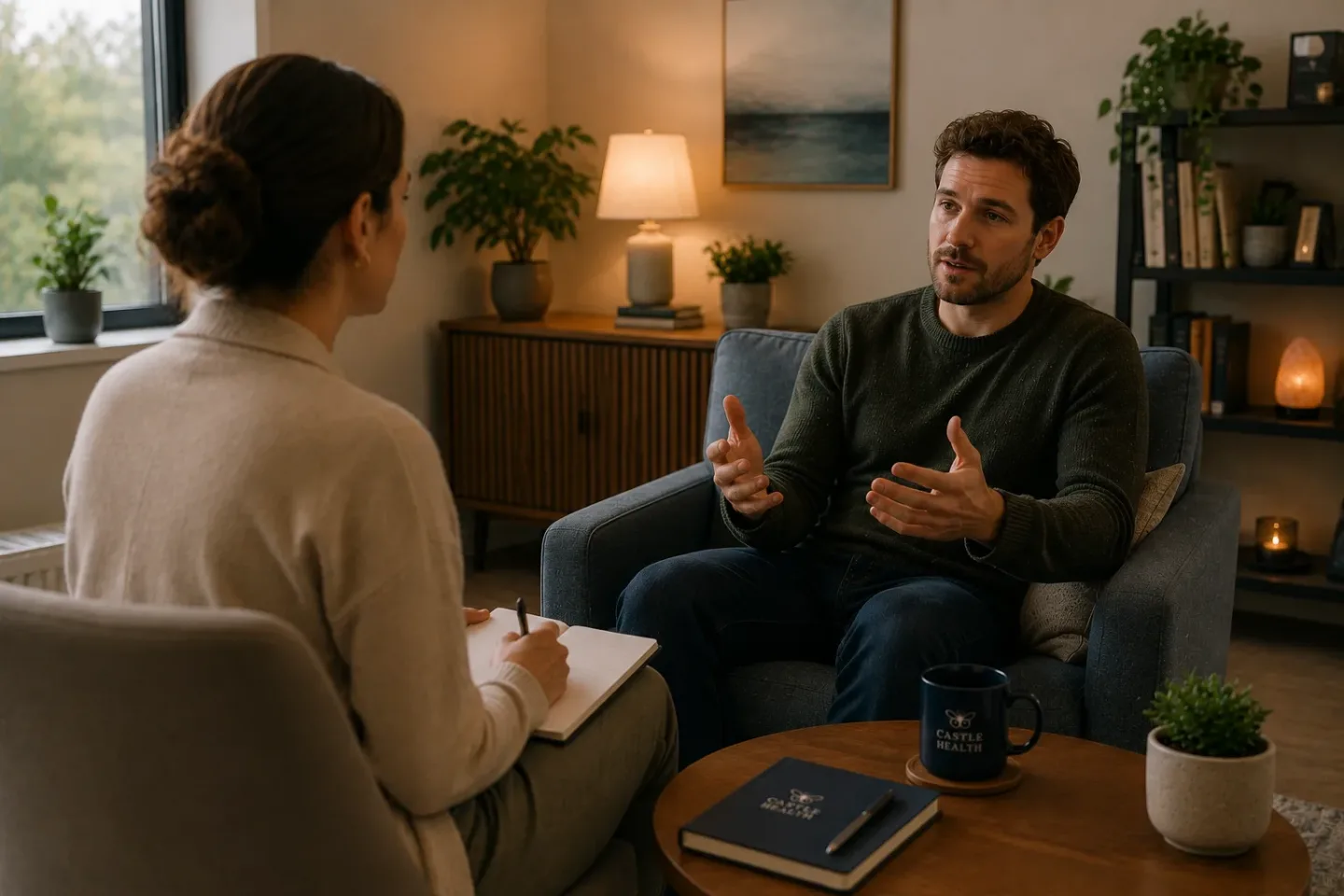
One-to-one therapy at Castle Health is built around addiction recovery specifically. From the first week, you work with one named focal therapist who has read your file before you meet. They lead your sessions, remain with you throughout your time here, and coordinate your wider care around what emerges in the room. That relationship is the spine of your treatment.
Individual therapy works in tandem with every other element of the programme. What you work through privately is reinforced in group therapy, family work, and the residential structure around it.

Approaches used in one to one therapy at Castle Health
Your focal therapist will draw on a range of approaches, shaped by your treatment plan.



"I contacted Castle Health seeking guidance and options to support a relative who was having a difficult time both with addiction and other mental health concerns. The team were incredibly kind and informed, they took the time to go through all the options with me and helped us plan how to approach the matter. Fortunately the person has now been receiving care from Castle Health for several months and is doing really well."

What is one to one therapy in addiction treatment?
One to one therapy in addiction recovery isn’t the same as general counselling. The goal is to help you understand what has kept the addiction going, and change it.
At Castle Health, individual therapy sessions:
- Are 50 minutes long
- Take place weekly – with more frequent contact during the first week of treatment
- Have a purpose
- Provide the space to allow you to dig deeper, or draw back
Individual addiction therapy sessions draw on a range of evidence-based approaches:
- Cognitive Behavioural Therapy (CBT) helps you recognise and reframe the thought patterns that drive relapse
- Dialectical Behaviour Therapy (DBT) builds emotional regulation skills
- Trauma-informed approaches are used carefully, at the right point in treatment, for people whose use has been shaped by traumatic experience.
Which approach is used, and when, is decided throughout your organically evolving, personalsied treatment plan.

Your focal therapist
From the moment you arrive, you are assigned a focal therapist. They’re the consistent clinical presence, leading your individual sessions, coordinating your care within the wider multidisciplinary team, and facilitating your family sessions when the time is right.
Research shows that longer, sustained engagement in treatment produces better outcomes. So, unlike a rotation of different practitioners, a focal therapist can track progress across the full arc of treatment and, if something shifts or something new comes up, they know about it and can help tailor the approach to best suit the individual’s needs.
How sessions are structured
In the first week, the priority is assessment. Your focal therapist builds a clear picture of your history, your patterns, and the factors most likely to put your recovery at risk. An individualised treatment plan is drawn up from that assessment and reviewed regularly as your treatment progresses.
From there, individual sessions run alongside group therapy, psychoeducational workshops, and community life. Sessions are structured, with a clear purpose for each.
When one to one therapy is right for you
A study in APA Psychnet found that psychological therapy produces meaningful change in people with substance addiction.
For people who find the idea of group work daunting at first, one-to-one sessions provide a safer environment to begin opening up.
Individual therapy is especially important for people with a co-occurring mental health condition, such as depression, anxiety, PTSD, or a significant trauma history.
Locations designed to support your recovery
Castle Health operates residential treatment programmes across the UK and Ireland. Our treatment settings are designed to provide structure, safety, and space to focus entirely on your recovery.






"Real change starts with a conversation.”
How one to one therapy fits into your wider treatment programme
Individual addiction therapy is the thread that runs through our whole residential rehab programme. The work goes beyond the fifty minutes you spend in a session.
What you work on privately comes up again in group therapy, and what surfaces in group comes back into your individual sessions.
Daily life between sessions is where the same things get tested.

From assessment to individualised treatment plan
Your focal therapist gathers a full picture of your history, your mental health, your family situation, and the factors most likely to affect your recovery during the first week.
From that, an individualised treatment plan is written, reviewed by the wider multidisciplinary team, and shared with you.
The plan shapes what happens in your individual sessions, what assignments you are given, and what continuing care will look like after you leave. The plan is reviewed and updated as you progress. Your therapist will discuss any changes with you directly.
Continuing one to one support after treatment
The individual therapy relationship doesn’t end at discharge from regular sessions. Through our continuing care and aftercare programme, support continues from home. Online individual sessions, group continuing care, and access to your wider recovery plan are all part of what comes next.
Recovery isn’t a six-week event, and the work doesn’t stop when you leave. The evidence consistently shows that sustained engagement over time produces better outcomes than a short, intensive treatment with no follow-up.




When someone in your life might benefit from one to one therapy
If someone you know has an addiction, it’s common to feel helpless and not know where to start. If they’ve been managing it for a long time, it can be hard to know what to suggest. You may have tried talking to them and not got anywhere, or you may not know where to begin.
Having one named therapist from the start often makes treatment feel less daunting. The thought of sitting in a group with strangers puts a lot of people off. Individual therapy is usually where they’re willing to start.
Castle Health has significant experience with dual diagnosis. If the person in your life is dealing with depression, anxiety, or PTSD alongside their addiction, our programme is built for that.
When addiction affects one person, it tends to affect everyone around them. Family therapy is a core part of the Castle Health programme. Family members are invited to attend workshops on understanding addiction even if they’re not part of formal therapy sessions.
If you have questions about what treatment looks like, even before the person in your life is ready to talk, our admissions team can help. The first call is just a conversation.

Speak to our admissions team
If you want to understand whether Castle Health is the right fit, our admissions team is here to talk. You don’t need to have made a decision, and you don’t need to know what to say. The call is free and confidential.
Get help today
Take the first step in your recovery journey
We are here to listen, guide and help you every step of the way. Call us today and together we can find a solution that suits you.
Our admissions process is confidential and designed to suit and support you and your circumstances. Find out more about the Admissions process.
Telephone
From the UK: 0131 287 4071
International: +44 (131) 287 4071
Care to the highest standards
Committed to quality care
One to one therapy: your questions answered
What are the typical costs for one to one therapy in the UK?
Private individual therapy in the UK typically ranges from £60 to £150 per session depending on the therapist and setting. At Castle Health, one to one therapy is included within the cost of the residential treatment programme.
For a full breakdown of costs, our admissions team can talk you through the options.
What's the difference between one to one therapy and one to one counselling?
The terms are often used interchangeably, but there is a practical distinction in addiction treatment. Counselling tends to refer to a shorter-term, more directive form of support focused on specific issues or decisions. Therapy, particularly in a residential setting, goes deeper and takes longer. At Castle Health, individual therapy is delivered by trained therapists within a full, personalsied clinical programme.
Will my one to one therapy sessions be confidential?
Yes. What you discuss in individual sessions is confidential. There are some exceptional limits to confidentiality, and we explain them clearly when you arrive.
Your focal therapist will only share information with the wider multidisciplinary team where it’s clinically relevant to your care, and only with your knowledge. Family members don’t have access to the content of your sessions.
Can I have one to one therapy without group therapy?
At Castle Health, group therapy is a core part of the residential programme and isn’t optional. This is because the evidence strongly supports an integrated approach, where individual and group work reinforce each other.
If you have concerns about group therapy, that is something to raise honestly with the admissions team or your focal therapist. Most people arrive with those concerns but find the group experience is different from what they’d imagined. We build up to group work gradually, and your focal therapist decides when you’re ready.
How is one to one therapy at Castle Health different from talking therapy on the NHS?
NHS talking therapy, delivered through programmes like IAPT, is primarily designed for common mental health conditions such as anxiety and depression. It’s typically six to twelve sessions, and designed for common mental health conditions rather than addiction.
At Castle Health, individual therapy is addiction-specific and delivered within a full residential environment. It runs alongside medical care, group therapy, family work, and a continuing care plan. The depth, intensity, and continuity are substantially different.