
United Kingdom
Castle Craig, Scotland
Find out more
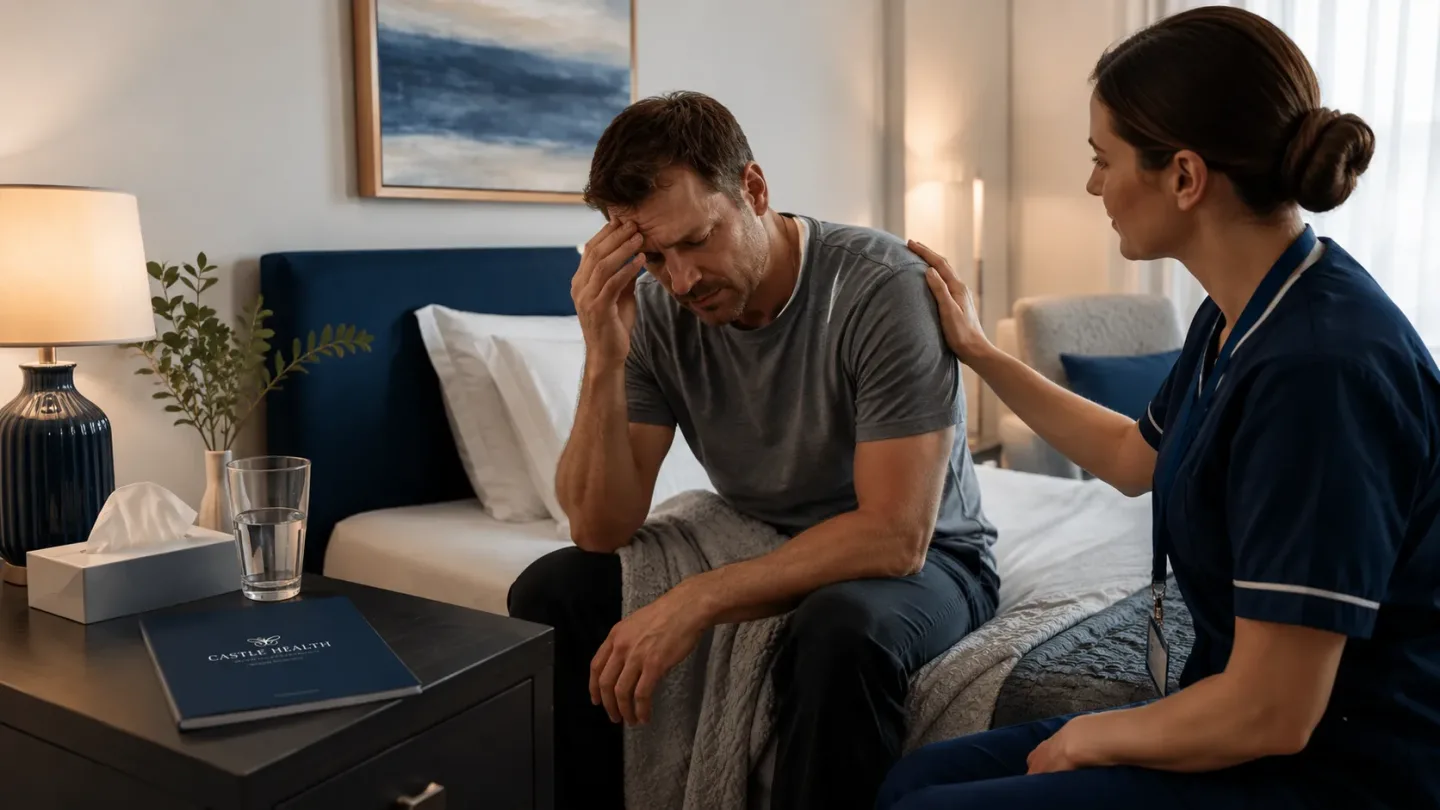

Opioid withdrawal can be one of the more physically demanding detox processes. It is also one of the most important to manage with medical expertise, oversight, and support.
Opioid detox applies regardless of how use began. For many, dependency can develop from a legitimate prescription rather than recreational or illicit use; the body doesn’t make any distinctions once it has become physically dependent.
Castle Health offers residential opioid detox across accredited clinics serving the UK, Ireland, and wider Europe – each consultant-led with 24-hour medical supervision.

Physical dependence on opioids means your brain and body have adapted to living with the drug present. When you stop, or significantly reduce what you’re taking, the body has to readjust. That’s what drives withdrawal.
The key area in the brain where this happens is at the base. It’s a cluster of neurons that produces noradrenaline – a chemical involved in alertness, heart rate, blood pressure, and the basic stress response.
During regular opioid use, this region works in a quietened state. When opioids are removed, it becomes overactive and releases a surge of noradrenaline. This is what drives withdrawal symptoms.
Put simply, your body enters a heightened state of alert in withdrawal. The symptoms are intense, but have physiological explanation. And with the right medical support, they are more than manageable.
No two people go through opioid withdrawal in exactly the same way. How quickly symptoms begin, their intensity, and how long they last all depend on factors including the type of opioid taken, how long and how frequently it’s been taken, overall health, other medications, and whether you have gone through withdrawal before.

For short-acting opioids, symptoms typically begin within 8 to 24 hours of the last dose and typically lasts four to ten days. For long-acting opioids like methadone, onset is 12 to 48 hours, and the withdrawal period extends to 10 to 20 days. The first three days are the most intense for most people.
Early symptoms most commonly include:
The World Health Organization’s Clinical Guidelines suggests symptoms typically reach their most intense point between 24 and 72 hours after the last dose.
It can involve:
By days four to seven, physical symptoms generally begin to ease. Sleep, appetite, and energy start to return.
The body is not fully recovered, but there is usually a clear shift away from the acute phase. Psychological symptoms can persist, and close support remains important throughout this period.
For most people, withdrawal doesn’t end when the acute phase resolves. The UK Guidelines on Clinical Management of Drug Misuse and Dependence describe a protracted withdrawal syndrome that can follow the acute phase.
Low mood, poor sleep, and persistent craving can persist for weeks or months.
This is post-acute withdrawal syndrome, or PAWS. If you’ve tried stopping before and found the difficulty lasted longer than you expected, this may likely be why. This stage is a well-documented phase of recovery, and one that we’re here to support you through.
The psychological dimension of opioid withdrawal is often underestimated. The UK Government’s Opioid Substitution Treatment guide for keyworkers identifies depression, anxiety, restlessness, irritability, sleep disorders, and intense drug craving as self-reported withdrawal symptoms.
These are distinct from the observable physical signs, and for many, these are harder to manage than physical symptoms. They don’t always resolve at the same rate. That’s why detox needs to transition into broader treatment, not end at physical stabilisation.
“In 33 years of sobriety and over 30 years as a clinician, I’ve learned that recovery isn’t about giving something up. It’s about putting down the substance, grieving, then creating a meaningful life that you no longer want to escape.”

The physical symptoms of opioid withdrawal are uncomfortable, but they are rarely directly life-threatening when properly managed. The greatest risks can come when someone decides to “go it alone”. For example:
The most serious risk is what happens if someone relapses during or after an unsupervised withdrawal attempt. Tolerance drops quickly once opioid use stops. The dose that felt normal before quitting can be enough to cause fatal overdose now, even after a short period without opioids.
A 2022 study found, across nearly 21,000 patients, that the first four weeks after treatment ended represent a period of significantly elevated overdose risk. The study focused specifically on people receiving opioid agonist treatment, but the underlying mechanism, reduced tolerance after a period without opioids, applies whenever someone stops and then uses again.

Medically managed opioid detox starts with a clinical assessment. Experts check:
What they learn shapes your detox plan. Throughout the detox, you are monitored closely. Your vital signs and symptoms are tracked and responded to in real time.
Medications prescribed prior to admission, if necessary, can be safely adjusted by the medical team.
As your body stabilises, detox transitions into the broader residential treatment programme.

Not everyone who undergoes opioid detox will need medication. Where it is used, the most common options include:

partially activates opioid receptors to reduce withdrawal symptoms and cravings. Research indicates it’s started 12 to 18 hours after the last dose of a short-acting opioid, or 24 to 48 hours after a long-acting opioid such as methadone. It’s vital to commence Buprenoprhine once opioid withdrawal is clear, in order to avoid causing a sudden, intense onset of opioid withdrawal symptoms
Methadone is a longer-acting opioid used to stabilise withdrawal and reduce the intensity of symptoms.
non-opioid medications can reduce the hyperactivity of the nervous system during withdrawal, easing anxiety, raised blood pressure, and muscle discomfort.
According to the European Union Drugs Agency (EUDA), methadone and buprenorphine are the most widely used opioid agonist treatment medications in Europe. They work by stabilising your brain and soothing craving and withdrawal. Within residential detox, they are used as a short-term clinical tool rather than in the long-term maintenance context the EUDA data primarily covers.
Detox medications are used as a short-term clinical tool, for a defined period, under close supervision. All prescribing decisions are made by the medical team led by a Consultant Psychiatrist and reviewed regularly throughout.
The aim is to give your body the best possible conditions to stabilise. If this is a concern you have, raise it when you speak with our team. You will receive a clear account of how any medication would be used in your specific care plan.
The first step is a free, confidential assessment with a member of our clinical team. This is a clinical conversation about your history, your health, and what you need. It determines the right level of care and the right clinic for you.
If Castle Health is the right fit, our admissions team will guide you through everything that happens in our clinic. The opening days of medical detox involve close monitoring, with your detox plan adjusted as you get used to it.
As withdrawal stabilises, detox transitions into inpatient treatment, the broader residential programme. Detox clears opioids from your body. Treatment addresses the reasons behind your opioid use and builds the foundations for sustainable recovery.
For more on what happens beyond detox, see our pages on opioid addiction treatment and relapse prevention.

Opioid withdrawal is very difficult to manage without clinical support. Residential detox addresses a medical risk, not a comfort preference. Reduced tolerance after even a brief period without opioids substantially raises the risk of overdose if the person starts using again.
It’s common to be told that home withdrawal is possible. That conversation is worth having carefully. A call to our team doesn’t commit anyone to anything. It opens a clinical conversation about what the options are.
Castle Health’s free assessment is available to families as well as to the people they are trying to support. If you aren’t sure where to start, our team can help. You can also read more about prescription drug addiction if your concerns relate specifically to prescription opioid use.

We are here to listen, guide and help you every step of the way. Call us today and together we can find a solution that suits you.
Our admissions process is confidential and designed to suit and support you and your circumstances. Find out more about the Admissions process.
From the UK: 0131 287 4071
International: +44 (131) 287 4071
We don’t recommend unsupervised opioid withdrawal at home. The physical symptoms, including severe vomiting, diarrhoea, and the risk of dehydration, require medical monitoring. The psychological symptoms, including severe anxiety and depression, can become overwhelming without clinical support. Most importantly, if you relapse after a period without opioids, your tolerance will have dropped. The dose that felt normal before could now cause an overdose. Medically supervised residential detox addresses all of these risks.
Medical detox addresses physical dependence. It clears opioids from the body and manages withdrawal safely. But it doesn’t address what sits beneath the physical dependence: the behavioural patterns and psychological drivers that maintain it. Detox is the first step. Opioid addiction treatment is what follows, and it’s where the longer work of recovery happens.
The withdrawal experience is broadly similar regardless of whether the opioid was prescribed or illicit. The main clinical difference is timing. Short-acting opioids, including most prescription painkillers, oxycodone, and heroin, tend to produce faster-onset, shorter-duration withdrawal. Long-acting opioids like methadone produce slower-onset, longer-duration withdrawal. The clinical recommendation, medically supervised detox, is the same either way.
For short-acting opioids, symptoms typically begin within 8 to 24 hours of the last dose. For long-acting opioids such as methadone, onset is usually 12 to 48 hours or later. These timelines are established in the World Health Organization’s Clinical Guidelines for Withdrawal Management.
Yes. All three Castle Health clinics, Castle Craig, Smarmore Castle, and Beroendekliniken, accept patients from outside their home countries. If you are based outside the UK, Ireland, or Sweden and want to understand the admissions and travel process, please contact our team directly. We can talk through the options with you.