Call Us Now: +44 1721 360 045
What is the CAGE questionnaire?
The CAGE questionnaire is one of the most widely used screening tools in alcohol use disorder assessment. It was developed by Dr John Ewing, MD, at the University of North Carolina, and was later published in the Journal of the American Medical Association (JAMA) in 1984. It has since been validated across decades of clinical research as a good first step in identifying whether someone’s relationship with alcohol may be causing harm.
It is not a diagnostic tool. It does not replace a clinical assessment, and a score alone cannot tell you whether you have alcohol use disorder. What it can do is give you a starting point: a way to reflect honestly on your drinking and decide whether speaking to someone would help.
That matters because one of the most common barriers to getting help is not knowing how severe your dependence might be. Many people aren’t sure whether their drinking is “bad enough” to warrant support. The CAGE questionnaire helps cut through that uncertainty, not by labelling you, but by prompting the kind of honest self-reflection that so often precedes meaningful change.
How does the CAGE questionnaire work?
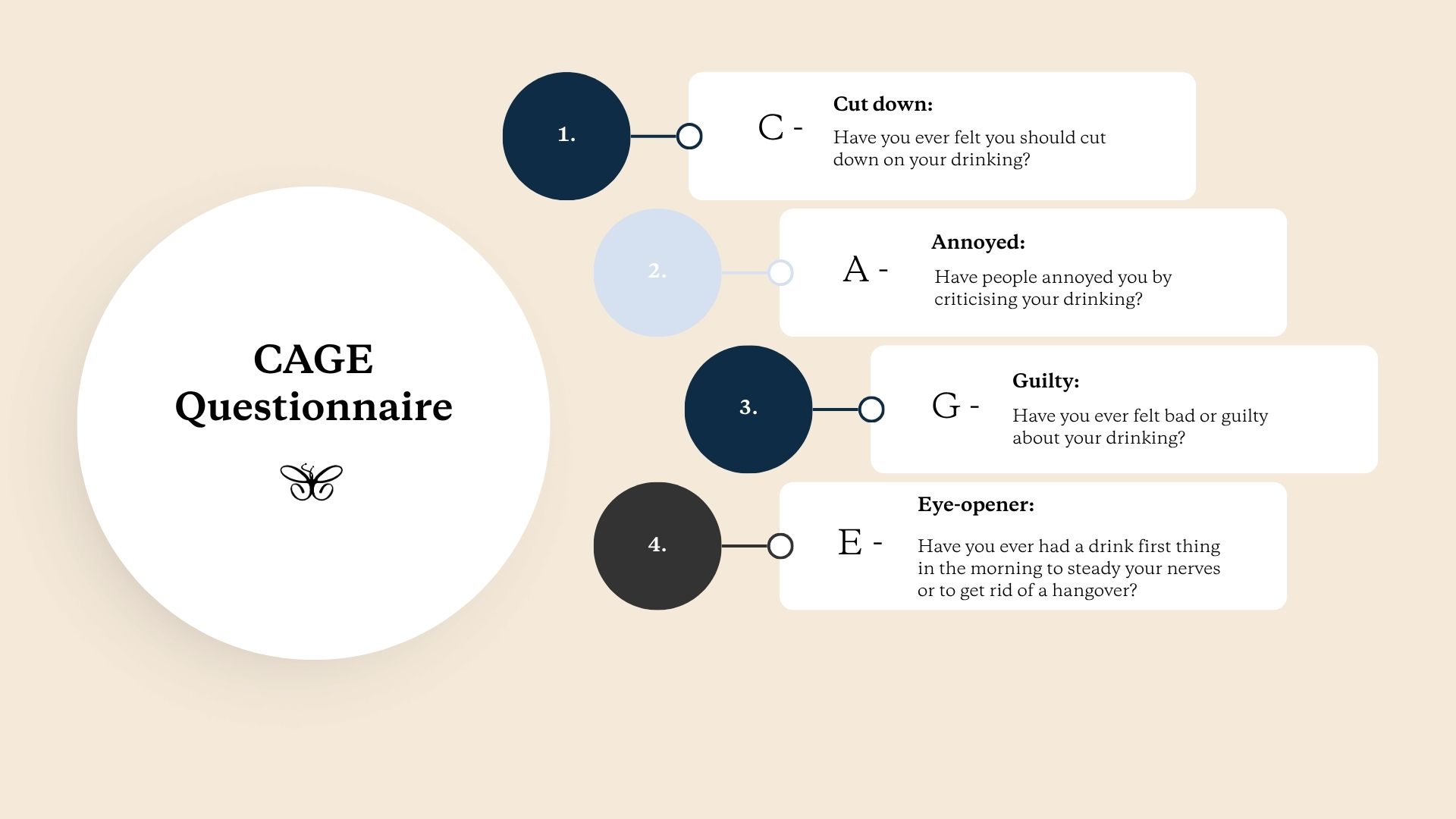
CAGE is an acronym. Each letter stands for one of four questions, each designed to identify a specific behavioural pattern associated with problematic alcohol use.
The questionnaire takes less than two minutes to complete. You answer yes or no to each question, and your responses are scored accordingly. A score of two or more suggests that further assessment would be beneficial.
What questions will I be asked in the CAGE questionnaire?
The four questions are:
C — Cut down: This question asks whether you have thought about cutting down.
A — Annoyed: This asks whether you have felt annoyed about someone commenting on your drinking.
G — Guilty: This question asks whether you have ever felt guilt about drinking.
E — Eye-opener: This identifies whether or not alcohol is the first thing consumed in the morning.
Each “yes” scores one point. The maximum score is four.
Understanding your CAGE questionnaire results
Score of 0: Your responses don’t indicate alcohol dependence at this time. That said, if you have any concerns about your drinking, even ones that didn’t surface here, it is always worth speaking to your GP.
Score of 1: A single positive response can indicate a developing pattern worth monitoring. It may not point to dependence, but it is worth reflecting on. Speaking to a professional can help you establish what is happening and why.
Score of 2 or more: A score of two or more is considered clinically significant. This does not mean you have a diagnosis, but it does suggest that a full assessment with a qualified professional would be a sensible next step. Many people who score at this level may find that speaking to someone is a useful next step in understanding where they are
It is important to be honest with yourself when completing this questionnaire. There is no right or wrong answer, only the truth of your own experience.
What do I do after completing my alcohol addiction questionnaire?
Whatever your score, you do not need to figure out the next step alone.
If your results have raised questions for you, the most useful thing you can do is speak to someone who can help you make sense of them. That might be your GP, or a specialist addiction therapist at Castle Health.
We offer confidential assessments with experienced clinicians who can talk through what your results mean, what your options are, and what treatment (if any) might be right for you. There is no pressure and no obligation. Our role at this stage is simply to help you understand where you are and what comes next.
If you are in a place of acute distress or feel you may be dependent on alcohol, please do not stop drinking suddenly without medical guidance. Alcohol withdrawal can be medically serious, and a safe, supervised detox is the right starting point for many people.
Choosing the right treatment
If a fuller assessment confirms that your drinking has become problematic, there are several evidence-based treatment options available. For people who are physically dependent on alcohol, medically supervised detox is usually the first step, providing a safe, structured withdrawal managed by medical professionals. From there, treatment might involve residential care, an outpatient or day programme, or a combination of both, depending on the severity of your alcohol use and your personal circumstances.
Aftercare is part of every pathway we offer. Recovery does not end at discharge, and our support doesn’t either.
Whatever the right option turns out to be, it will be based on a proper assessment of your individual needs.
A brief note on your results
The CAGE questionnaire is a preliminary screening tool only. It is not a diagnostic instrument and should not be interpreted as a clinical diagnosis of alcohol use disorder or any other condition.
A score of two or more indicates that a further assessment by a qualified healthcare professional is advisable. It does not confirm the presence of dependence.
If you are concerned about your alcohol use, please speak to your GP or contact our clinical team for a confidential assessment. If you believe you may be physically dependent on alcohol, please seek medical advice before making any changes to your drinking.